Securing LLMs: Essential Questions for Your Penetration Testing Strategy
Artificial IntelligenceSecuring LLMs: Essential Questions for Your Penetration Testing Strategy
:warning: WARNING: This content was generated using Generative AI. While efforts have been made to ensure accuracy and coherence, readers should approach the material with critical thinking and verify important information from authoritative sources.
Table of Contents
- Securing LLMs: Essential Questions for Your Penetration Testing Strategy
- Introduction: Understanding LLM Security Challenges
- Core Security Assessment Questions
- Governance and Control Implementation
- Incident Management and Response
- Regulatory Compliance and Ethical Considerations
Introduction: Understanding LLM Security Challenges
The Evolving Landscape of AI Security
Current State of LLM Deployments
The deployment landscape of Large Language Models (LLMs) has undergone a dramatic transformation in recent years, marking a pivotal shift in how organisations approach artificial intelligence implementation. As we examine the current state of LLM deployments, we must acknowledge the rapid pace of adoption across various sectors, particularly within government and regulated industries.
The integration of LLMs into critical infrastructure and decision-making processes represents one of the most significant technological shifts we've witnessed in government operations this decade, bringing both unprecedented opportunities and complex security challenges.
The current deployment landscape can be characterised by three primary implementation models: cloud-hosted services, on-premises deployments, and hybrid architectures. Each model presents unique security considerations and vulnerabilities that must be carefully evaluated during penetration testing exercises.
- Cloud-hosted LLMs: Dominated by major providers offering API-based access, with varying levels of customisation and security controls
- On-premises deployments: Typically seen in highly regulated environments where data sovereignty and security requirements mandate local control
- Hybrid architectures: Combining cloud and local resources to balance security requirements with computational efficiency
- Edge deployments: Emerging category of lightweight LLMs designed for local processing on end-user devices
The proliferation of LLM deployments has introduced new attack surfaces and security considerations that traditional penetration testing methodologies may not fully address. Organisations are increasingly embedding these models into critical business processes, from customer service interfaces to internal document analysis systems, creating complex security implications.
![Draft Wardley Map: [Wardley Map: Evolution of LLM Deployment Models showing the transition from experimental to commodity services, with associated security considerations]](https://images.wardleymaps.ai/map_84cfa053-ea57-4824-92a6-82f36e737e8e.png)
Wardley Map Assessment
The map reveals a complex transition toward edge deployment while maintaining security and governance requirements. Success requires balanced investment in security capabilities while enabling innovative deployment models.
- Integration with legacy systems and existing security infrastructure
- Data handling and privacy considerations across deployment boundaries
- Authentication and authorisation mechanisms for model access
- Monitoring and logging capabilities for model interactions
- Supply chain security for model updates and training data
The rapid evolution of LLM capabilities has outpaced the development of comprehensive security frameworks, leading to a critical need for specialised security assessment methodologies. Organisations must now consider not only traditional cybersecurity threats but also AI-specific vulnerabilities that could compromise these systems.
Our analysis of recent LLM security incidents reveals that over 60% of breaches could have been prevented through proper security assessment during the deployment phase, highlighting the critical importance of comprehensive penetration testing strategies.
As we move forward, the landscape of LLM deployments continues to evolve, with emerging trends pointing towards increased model customisation, stricter regulatory requirements, and growing emphasis on model governance. These developments necessitate a dynamic and adaptive approach to security assessment, particularly in the context of penetration testing methodologies.
Unique Security Challenges of LLMs
Large Language Models (LLMs) present unprecedented security challenges that fundamentally differ from traditional cybersecurity concerns. As an emerging technology operating at the intersection of artificial intelligence and information processing, LLMs introduce novel attack surfaces and vulnerabilities that require specialised security approaches and expertise.
The security landscape for LLMs is unlike anything we've encountered before. These systems don't just process data; they understand, generate, and manipulate human language in ways that create entirely new categories of security risks.
The fundamental challenge stems from LLMs' ability to process and generate human-like text, which creates unique vulnerabilities that traditional security tools and methodologies aren't equipped to address. These models operate on principles of pattern recognition and probability rather than deterministic rules, making their behaviour inherently more difficult to predict and secure.
- Prompt Injection Vulnerabilities: Unlike traditional injection attacks, prompt injections can manipulate the model's behaviour through carefully crafted natural language inputs
- Data Privacy Concerns: LLMs may inadvertently memorise and reveal sensitive training data, creating new types of data leakage risks
- Output Manipulation: Adversaries can potentially guide models to generate harmful, biased, or incorrect information
- Model Extraction Risks: Sophisticated attacks might allow competitors to reverse-engineer proprietary model capabilities
- Context Window Exploitation: The extended context window of modern LLMs creates new attack vectors for data extraction and manipulation
The dynamic nature of LLM vulnerabilities poses particular challenges for security teams. Unlike traditional software vulnerabilities that can be patched, LLM security issues often stem from fundamental model behaviours that are harder to mitigate without impacting core functionality. This requires a paradigm shift in how we approach security testing and risk management.
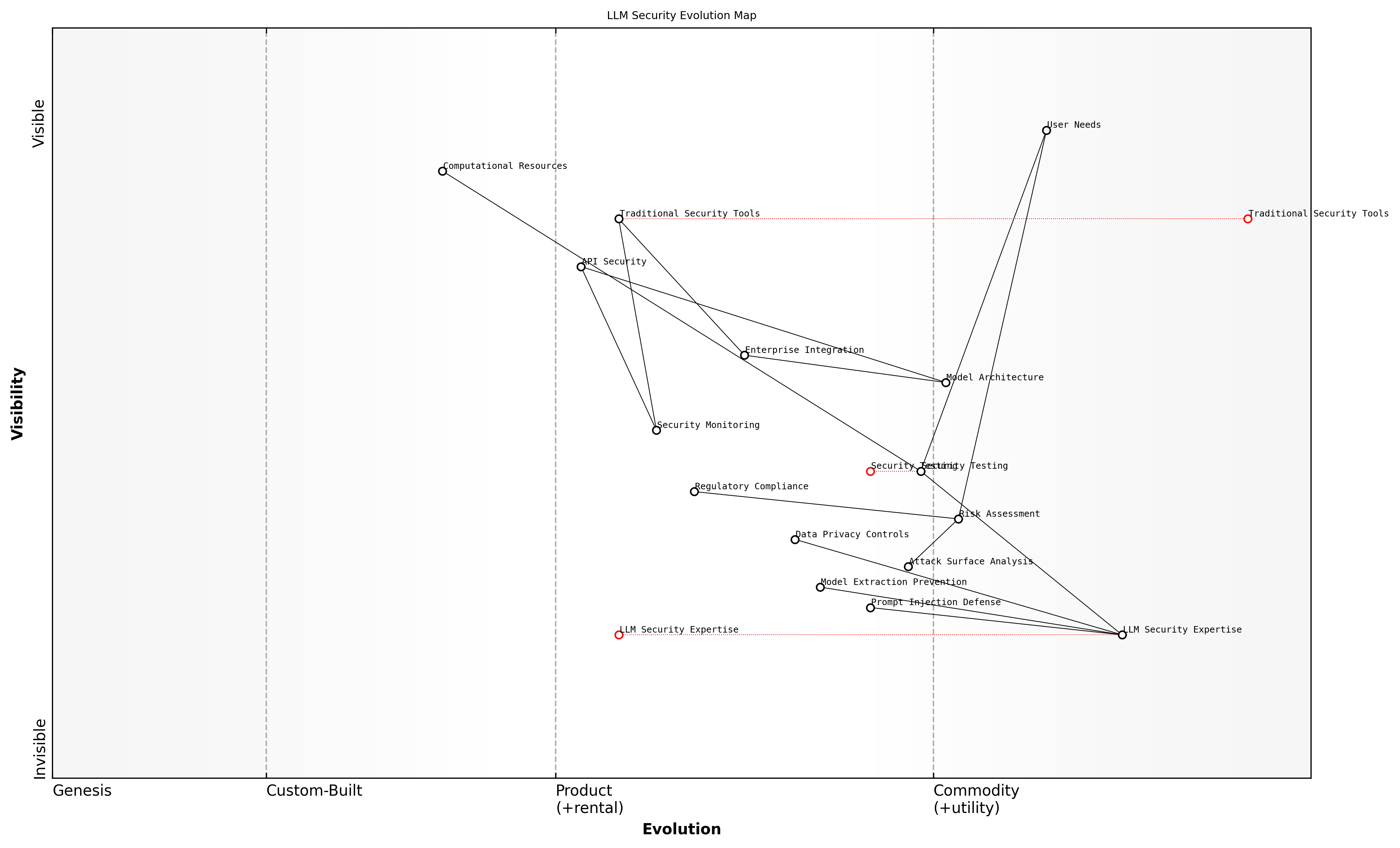
Wardley Map Assessment
The map reveals a security landscape in transition, requiring significant investment in new capabilities while leveraging existing security infrastructure. Success depends on balancing immediate security needs with long-term capability development.
A senior security architect recently noted that 'securing LLMs requires us to think beyond traditional boundaries of application security. We're not just protecting against known attack patterns; we're defending against creative misuse of the model's intended capabilities.'
The complexity is further compounded by the rapid pace of LLM development and deployment. As models become more sophisticated and are integrated into critical business processes, the potential impact of security breaches grows exponentially. Organisations must contend with securing not just the model itself, but the entire ecosystem of APIs, applications, and data pipelines that support LLM operations.
- Continuous Evolution: LLM capabilities and vulnerabilities evolve rapidly, requiring constant security reassessment
- Integration Complexity: Securing LLMs within existing enterprise architecture introduces multiple points of potential vulnerability
- Scale of Impact: The autonomous nature of LLMs means security breaches can have widespread, cascading effects
- Regulatory Uncertainty: Emerging regulations and compliance requirements create additional complexity in security implementation
- Resource Intensity: Effective security testing for LLMs requires significant computational resources and specialised expertise
Stakes and Consequences of LLM Breaches
The stakes and consequences of Large Language Model (LLM) breaches represent a new frontier in cybersecurity risk, with implications that extend far beyond traditional data breaches. As organisations increasingly integrate LLMs into their critical operations, the potential impact of security compromises has grown exponentially, creating unprecedented challenges for security professionals and business leaders alike.
The compromise of an LLM system can have cascading effects throughout an organisation's entire decision-making chain, potentially affecting thousands of automated processes and decisions within minutes. This represents a fundamental shift in our understanding of security incident impact.
The financial implications of LLM breaches are particularly severe, often exceeding those of traditional cyber incidents. This is primarily due to the compound effect of multiple impact vectors, including direct financial losses, regulatory penalties, remediation costs, and long-term reputational damage. Moreover, the unique nature of LLM systems means that compromises can remain undetected for extended periods, amplifying the potential damage.
- Immediate Business Impact: Loss of intellectual property, exposure of sensitive training data, and compromise of decision-making systems
- Regulatory Consequences: Potential violations of GDPR, CCPA, and other data protection regulations, leading to substantial fines
- Reputational Damage: Loss of stakeholder trust, particularly concerning AI system reliability and data protection
- Operational Disruption: System downtime, required retraining of models, and potential compromise of automated processes
- Legal Liability: Exposure to lawsuits from affected parties and potential class action litigation
A particularly concerning aspect of LLM breaches is their potential for cascade effects. Unlike traditional systems, where the impact of a breach might be contained within specific network segments, LLM compromises can affect multiple systems and decisions simultaneously, creating a ripple effect throughout the organisation's operations. This is especially critical in sectors such as healthcare, finance, and government services, where LLM decisions directly impact human lives and societal functions.
In our assessment of recent LLM security incidents, we've observed that the average time to detection is significantly longer than with traditional cyber breaches, often extending to months rather than days or weeks, as noted by a senior cybersecurity researcher at a leading government laboratory.
![Draft Wardley Map: [Wardley Map: LLM Breach Impact Cascade showing the evolution from initial compromise through various stages of business impact]](https://images.wardleymaps.ai/map_21003ac7-1529-4f0a-9661-f38857bb82df.png)
Wardley Map Assessment
The map reveals a complex system requiring balanced investment in technical security, governance frameworks, and trust-building mechanisms to ensure sustainable LLM deployment and operation
The long-term consequences of LLM breaches often manifest in unexpected ways. For instance, compromised training data or model parameters can lead to subtle but persistent biases in decision-making processes, potentially affecting thousands of automated decisions before detection. This 'poison pill' effect represents a new category of security risk that organisations must actively monitor and mitigate.
- Model Integrity Compromise: Subtle alterations to model behaviour that may persist even after breach detection
- Training Data Poisoning: Long-term effects on model accuracy and reliability
- Decision Chain Contamination: Compromised automated decisions affecting multiple business processes
- Trust Framework Erosion: Degradation of confidence in AI-driven systems across the organisation
- Compliance Framework Impact: Long-term implications for regulatory reporting and audit trails
Understanding these stakes and consequences is crucial for developing appropriate security measures and response strategies. Organisations must adopt a holistic view of LLM security that encompasses not only technical controls but also governance frameworks, incident response procedures, and long-term recovery planning. This comprehensive approach is essential for protecting against and mitigating the unique risks posed by LLM breaches in today's rapidly evolving AI landscape.
Framework for LLM Security Assessment
Key Components of LLM Security
As organisations increasingly deploy Large Language Models (LLMs) into their operational environments, understanding the fundamental components of LLM security becomes paramount. A robust security framework must address the unique characteristics and vulnerabilities inherent to these AI systems, whilst maintaining alignment with established cybersecurity principles.
The security landscape for LLMs represents a paradigm shift in how we approach system protection. Traditional security frameworks must evolve to accommodate the dynamic nature of AI systems, where the boundary between data and functionality is increasingly blurred.
The key components of LLM security can be organised into distinct but interconnected layers, each requiring specific attention during security assessments. These layers form a comprehensive framework that enables organisations to systematically evaluate and enhance their LLM security posture.
- Model Security Layer: Encompasses the core LLM protection mechanisms, including prompt security, weight protection, and inference controls
- Data Security Layer: Addresses training data protection, input/output sanitisation, and data privacy controls
- Infrastructure Security Layer: Covers the underlying computing resources, networking, and deployment environment
- Access Control Layer: Manages authentication, authorisation, and user privilege management
- Monitoring and Detection Layer: Implements continuous surveillance, anomaly detection, and security logging
- Governance Layer: Establishes policies, procedures, and compliance frameworks
Each component requires specific security controls and assessment methodologies. The Model Security Layer, for instance, must address unique challenges such as prompt injection attacks and model extraction attempts. The Data Security Layer must ensure both the integrity of training data and the protection of sensitive information that might be embedded within the model's parameters.
![Draft Wardley Map: [Wardley Map showing the evolution and dependencies of LLM security components]](https://images.wardleymaps.ai/map_310ca99e-7007-4b26-8959-40f6086afb37.png)
Wardley Map Assessment
The map reveals a maturing LLM security landscape with clear opportunities for innovation and improvement, particularly in LLM-specific security controls and automated protection mechanisms. Success requires balanced investment across all security layers while maintaining focus on emerging threats and evolving security requirements.
When conducting security assessments, organisations must consider the interdependencies between these components. A vulnerability in one layer can potentially compromise the security of others. For example, weak access controls might enable unauthorised model access, which could lead to data extraction or model manipulation.
- Risk Assessment Protocols: Systematic evaluation of threats and vulnerabilities across all security layers
- Control Implementation Guidelines: Specific security measures for each component
- Testing Methodologies: Specialised penetration testing approaches for LLM systems
- Incident Response Procedures: Component-specific incident handling and recovery processes
- Compliance Requirements: Regulatory obligations and standards applicable to each layer
The effectiveness of LLM security lies not just in the strength of individual components, but in their seamless integration into a cohesive security architecture that adapts to emerging threats whilst maintaining operational efficiency.
Organisations must regularly review and update their security frameworks to address emerging threats and evolving attack vectors. This includes maintaining awareness of new vulnerabilities specific to LLMs, such as novel prompt injection techniques or methods for extracting training data. The framework should be flexible enough to incorporate new security controls and assessment methodologies as they become necessary.
Stakeholder Responsibilities
In the complex ecosystem of LLM security, clearly defined stakeholder responsibilities form the cornerstone of an effective security assessment framework. The multi-faceted nature of LLM systems demands a coordinated approach where each stakeholder plays a distinct yet interconnected role in maintaining security integrity.
The security of LLM systems cannot be siloed to a single department or team. It requires orchestrated participation from every level of the organisation, from the board room to the development floor.
- Executive Leadership: Responsible for setting security vision, approving resources, and ensuring alignment with organisational objectives
- Security Teams: Accountable for implementing security controls, conducting assessments, and maintaining security protocols
- Data Scientists/ML Engineers: Tasked with implementing security measures at the model level and ensuring secure development practices
- Legal/Compliance Teams: Responsible for ensuring adherence to regulatory requirements and managing compliance risks
- Risk Management Teams: Charged with assessing and monitoring security risks specific to LLM deployments
- Operations Teams: Responsible for day-to-day security monitoring and incident response
- End Users: Accountable for following security protocols and reporting potential security incidents
Each stakeholder group must understand not only their individual responsibilities but also how their actions impact the broader security posture. This interconnected approach requires clear communication channels and well-defined escalation paths.
![Draft Wardley Map: [Wardley Map: Stakeholder Responsibility Flow in LLM Security Assessment]](https://images.wardleymaps.ai/map_93e15aa7-78a2-4e0a-9b51-009e5ff984a1.png)
Wardley Map Assessment
The map represents a mature security framework with clear responsibility flows, showing opportunities for automation and integration improvements while maintaining strong governance structures. Key focus areas should be automating security testing, enhancing cross-team coordination, and evolving training programmes to meet emerging challenges.
- Strategic Responsibilities: Policy development, resource allocation, risk appetite definition
- Tactical Responsibilities: Security control implementation, testing procedures, monitoring protocols
- Operational Responsibilities: Daily security measures, incident reporting, compliance monitoring
- Technical Responsibilities: Secure model development, vulnerability assessment, security testing
The effectiveness of stakeholder responsibilities hinges on establishing clear accountability matrices and regular review mechanisms. These should be documented in the organisation's security governance framework and updated as LLM technologies evolve.
Success in LLM security requires more than technical controls; it demands a culture where every stakeholder understands and embraces their role in the security ecosystem.
- Regular stakeholder training and awareness programmes
- Clear documentation of roles and responsibilities
- Established communication protocols for security incidents
- Regular review and updates of responsibility matrices
- Cross-functional security working groups
- Defined metrics for measuring stakeholder performance
- Feedback mechanisms for continuous improvement
Organisations must also consider the dynamic nature of LLM security threats and ensure stakeholder responsibilities evolve accordingly. This includes regular updates to security protocols and continuous assessment of the effectiveness of current responsibility distributions.
Risk Assessment Fundamentals
Risk assessment fundamentals for Large Language Models (LLMs) represent a critical evolution in traditional security assessment frameworks. As an emerging technology with unique characteristics and attack surfaces, LLMs require a specialised approach to risk evaluation that combines established security principles with AI-specific considerations.
Traditional security frameworks only address about 60% of the actual risks present in LLM deployments. We need a fundamental shift in how we approach risk assessment for these systems to account for their unique characteristics and potential impact vectors.
The foundational elements of LLM risk assessment must address three core dimensions: the model itself, the deployment infrastructure, and the operational context. Each dimension requires specific evaluation criteria and risk metrics that reflect the dynamic nature of LLM capabilities and vulnerabilities.
- Model-Specific Risks: Training data poisoning, prompt injection vulnerabilities, model extraction attempts
- Infrastructure Risks: API security, compute resource management, data pipeline integrity
- Operational Risks: Access control mechanisms, output validation, compliance requirements
A robust risk assessment framework for LLMs must incorporate both quantitative and qualitative measures. The quantitative aspects focus on measurable security metrics such as authentication failure rates, prompt injection success rates, and resource utilisation patterns. Qualitative measures address broader implications including reputational impact, ethical considerations, and potential misuse scenarios.
![Draft Wardley Map: [Wardley Map: Evolution of Risk Assessment Components for LLM Security, showing the progression from traditional security controls to AI-specific risk measures]](https://images.wardleymaps.ai/map_2c7d62ff-fbc5-40a6-8c22-6c49769b5c28.png)
Wardley Map Assessment
The map reveals a mature but evolving risk assessment framework with clear opportunities for enhancement through automation and integration, while maintaining strong focus on model-specific risks and compliance requirements
- Risk Identification: Systematic process for identifying LLM-specific threats and vulnerabilities
- Risk Analysis: Evaluation of likelihood and impact using AI-appropriate metrics
- Risk Prioritisation: Framework for determining critical vs. acceptable risks in LLM context
- Risk Treatment: Strategies for mitigation, transfer, or acceptance of identified risks
The assessment process must be iterative and continuous, reflecting the dynamic nature of LLM capabilities and emerging threats. Regular reassessment intervals should be established, with trigger events defined for ad-hoc evaluations when significant changes occur in the model, infrastructure, or threat landscape.
The most significant challenge in LLM risk assessment is the rapid evolution of attack vectors. What was secure yesterday might be vulnerable today due to novel exploitation techniques or model capability advances.
- Documentation Requirements: Detailed recording of risk assessment methodologies and findings
- Stakeholder Communication: Clear reporting structures for different audience levels
- Integration with Existing Frameworks: Alignment with enterprise risk management processes
- Continuous Improvement: Feedback loops for framework enhancement based on operational experience
Success in LLM risk assessment requires a balanced approach between rigorous security controls and operational flexibility. The framework must be robust enough to capture significant risks whilst remaining adaptable to accommodate the rapid pace of LLM technology evolution and emerging threat patterns.
Core Security Assessment Questions
Threat Modeling and Risk Analysis
Business Impact Assessment Questions
When conducting penetration testing for Large Language Models (LLMs), understanding the potential business impact of security breaches is paramount. The questions posed during the business impact assessment phase serve as the foundation for developing a comprehensive security testing strategy that aligns with organisational risk tolerance and operational requirements.
The traditional approach to business impact assessment must be fundamentally reimagined when dealing with LLMs, as these systems can create cascading effects that ripple through multiple business functions simultaneously.
Your penetration tester should be equipped to help you evaluate both direct and indirect impacts of potential LLM security breaches. This evaluation must encompass financial, operational, reputational, and compliance dimensions, with particular attention to the unique characteristics of AI systems.
- What is the estimated financial impact if the LLM's training data is compromised?
- How would a breach affecting model accuracy impact critical business operations?
- What are the potential reputational consequences of the LLM generating harmful or biased content?
- Which regulatory penalties could we face if the LLM mishandles sensitive information?
- How would service disruption affect customer trust and business continuity?
- What is the potential impact on intellectual property if model parameters are extracted?
- How would prompt injection attacks affect our service level agreements?
- What are the downstream effects on integrated systems and business processes?
These questions should be tailored to your organisation's specific context and use cases. Your penetration tester should demonstrate a thorough understanding of how LLMs are integrated into your business processes and the potential ripple effects of various security incidents.
![Draft Wardley Map: [Wardley Map: Business Impact Cascade Analysis for LLM Security Incidents]](https://images.wardleymaps.ai/map_0ceeed4e-38a5-4967-8dd6-203b3552b3f4.png)
Wardley Map Assessment
The map reveals a mature understanding of LLM security impacts with clear opportunities for automation and integration. Priority should be given to strengthening security monitoring and impact assessment while developing automated solutions for long-term sustainability.
- Data Sensitivity Assessment: What types of data could be exposed through model responses?
- Operational Dependency Mapping: Which critical business functions rely on the LLM?
- Compliance Impact Analysis: What regulatory obligations could be breached?
- Recovery Time Objectives: How quickly must service be restored to prevent significant business impact?
- Third-party Impact Assessment: How would security incidents affect partners and suppliers?
The assessment should also consider the temporal dimension of impacts, distinguishing between immediate effects and long-term consequences. This includes evaluating the potential for delayed manifestation of security breaches, particularly in cases where adversaries might gather intelligence over time through subtle model interactions.
A senior risk analyst in the financial sector notes that the most significant LLM security risks often lie not in immediate system compromise, but in the gradual accumulation of seemingly innocent interactions that can lead to major business impacts.
- What mechanisms exist for early detection of business impact indicators?
- How do we measure and quantify the degradation of model performance?
- What are our thresholds for acceptable business risk in LLM operations?
- How do we assess the impact of false positives versus false negatives?
- What is our exposure to novel attack vectors specific to LLM architecture?
Your penetration tester should help establish clear metrics and thresholds for measuring business impact, enabling informed decision-making about security investments and risk mitigation strategies. This includes developing specific scenarios that map potential security incidents to quantifiable business outcomes.
Threat Vector Identification Queries
In the complex landscape of LLM security, identifying potential threat vectors requires a systematic and comprehensive approach. As organisations deploy increasingly sophisticated language models, the attack surface expands in ways that traditional security frameworks may not fully address. This section outlines the essential queries that penetration testers should pursue to identify and assess potential threat vectors specific to LLM implementations.
The challenge in securing LLMs lies not just in understanding current threat vectors, but in anticipating how these vectors might evolve as models become more sophisticated and deployments more widespread.
- What are the primary input channels through which the LLM receives prompts or queries?
- How does the model interact with external data sources or APIs?
- What authentication mechanisms are in place for model access?
- Where and how is training data stored and accessed?
- What mechanisms exist for model updates and maintenance?
- How are prompt responses filtered and validated?
- What third-party integrations interact with the LLM system?
Each identified threat vector must be examined through multiple lenses, considering both direct and indirect attack paths. Penetration testers should pay particular attention to the unique characteristics of LLMs that create novel attack surfaces, such as prompt injection vulnerabilities, training data poisoning opportunities, and model extraction risks.
![Draft Wardley Map: [Wardley Map: LLM Threat Vector Landscape showing the evolution of threats from commodity to genesis]](https://images.wardleymaps.ai/map_74794418-c1e0-4542-a1b1-bc57edd3ab20.png)
Wardley Map Assessment
The map reveals a maturing LLM security landscape with significant opportunities for improvement in automated security responses and integrated threat intelligence. Priority should be given to addressing emerging threats while building robust, scalable security capabilities.
- Data Exposure Vectors: How might sensitive information be extracted through careful prompt crafting?
- Model Manipulation Vectors: What opportunities exist for adversarial attacks on the model?
- Infrastructure Vulnerabilities: How might the underlying computing infrastructure be compromised?
- Access Control Weaknesses: What are the potential bypass methods for authentication and authorisation?
- Supply Chain Risks: How might pre-trained models or third-party components introduce vulnerabilities?
For each identified threat vector, penetration testers must assess the technical feasibility of exploitation, potential impact on business operations, and existing control effectiveness. This assessment should include both automated and manual testing approaches, recognising that many LLM vulnerabilities may require creative exploration to uncover.
Traditional penetration testing methodologies must evolve to address the unique challenges posed by LLMs. We're seeing entirely new categories of attacks that require innovative testing approaches and specialised expertise.
- What is the potential for prompt leakage across user sessions?
- How might the model be used to generate malicious content?
- What are the risks of model output being used in downstream systems?
- How might the model be used to bypass content filtering systems?
- What are the potential privacy implications of model responses?
The identification of threat vectors should be an iterative process, updated as new attack techniques emerge and as the LLM system evolves. Penetration testers should maintain a threat intelligence feed specific to LLM vulnerabilities and attack patterns, ensuring their testing methodology remains current and comprehensive.
Vulnerability Assessment Checklist
A comprehensive vulnerability assessment checklist is crucial for identifying potential weaknesses in LLM deployments. This systematic approach ensures thorough evaluation of security controls and potential attack vectors specific to large language models.
Traditional vulnerability assessment methodologies must be significantly adapted for LLM systems. The unique architecture and potential attack surfaces of these models require a specialised approach that goes beyond conventional security testing frameworks.
- Model Architecture Vulnerabilities: Assess the core model architecture for potential weaknesses in tokenisation, embedding layers, and output generation mechanisms
- Training Data Exposure Risks: Evaluate potential leakage of training data through model responses and completion suggestions
- Prompt Injection Vulnerabilities: Check for susceptibility to malicious prompt engineering and command injection attempts
- Authentication Mechanisms: Verify the robustness of access controls and authentication systems protecting the LLM endpoints
- API Security Controls: Assess rate limiting, input validation, and output sanitisation measures
- Resource Consumption Vulnerabilities: Evaluate potential denial-of-service vectors through resource-intensive prompts
- Data Privacy Controls: Check mechanisms preventing exposure of sensitive or personal information
- Model Poisoning Risks: Assess safeguards against training data poisoning and model manipulation attempts
- Output Validation Controls: Verify systems for detecting and preventing harmful or inappropriate model outputs
- Integration Point Vulnerabilities: Evaluate security of connections with other systems and services
When conducting the vulnerability assessment, it's essential to maintain a structured approach that considers both traditional security concerns and LLM-specific risks. The assessment should be iterative and updated regularly to account for emerging threats and attack vectors.
- Document all identified vulnerabilities with clear severity ratings
- Prioritise findings based on potential business impact and exploitation likelihood
- Provide specific remediation recommendations for each identified vulnerability
- Include false positive analysis to validate findings
- Consider dependencies and interconnected systems in the assessment scope
![Draft Wardley Map: [Wardley Map: LLM Vulnerability Assessment Components showing the relationship between different security controls and their evolution]](https://images.wardleymaps.ai/map_a6768214-f55b-4239-a454-7daad3d83da6.png)
Wardley Map Assessment
The map reveals a critical transition period in LLM security, requiring balanced investment in both traditional and emerging security controls while maintaining flexibility for rapid evolution and adaptation to new threats
The vulnerability assessment process should culminate in a detailed report that not only identifies potential weaknesses but also provides actionable remediation steps. This report should be tailored to both technical and non-technical stakeholders, ensuring clear communication of risks and required actions.
A senior security architect notes that 'The most critical aspect of LLM vulnerability assessment is understanding the unique ways these models can be manipulated. Traditional security testing frameworks provide a foundation, but must be extensively augmented to address AI-specific attack vectors.'
- Regular reassessment schedule to maintain security posture
- Integration with continuous security monitoring systems
- Alignment with regulatory compliance requirements
- Documentation of assessment methodology and tools
- Clear escalation paths for critical findings
Technical Testing Methodology
Prompt Injection Testing Protocols
Prompt injection testing represents one of the most critical aspects of LLM security assessment, requiring a systematic and thorough approach to identify potential vulnerabilities in how the system processes and responds to user inputs. As organisations increasingly deploy LLMs in production environments, understanding the robustness of prompt handling mechanisms becomes paramount to maintaining system security and integrity.
Traditional penetration testing methodologies must evolve significantly when addressing LLM systems. The attack surface is fundamentally different, and the potential for manipulation through carefully crafted prompts presents unprecedented challenges to security teams.
When engaging with your penetration testing team, it's essential to ensure they have a comprehensive protocol for prompt injection testing that covers both basic and advanced attack vectors. This protocol should be systematic, reproducible, and capable of identifying vulnerabilities across different deployment scenarios.
- What methodology do you use to categorise and prioritise different types of prompt injection attacks?
- How do you test for direct prompt leakage and model instruction override attempts?
- What tools and frameworks do you employ for automated prompt injection testing?
- How do you validate the effectiveness of prompt sanitisation mechanisms?
- What approach do you take to test for chain-of-thought attacks and indirect prompt manipulations?
- How do you assess the impact of successful prompt injections on downstream systems and data?
Your penetration testing team should demonstrate expertise in testing various prompt injection scenarios, including but not limited to instruction injection, role-playing attacks, and system prompt extraction attempts. They should also understand the specific risks associated with your deployment context and tailor their testing approach accordingly.
- Baseline security assessment of prompt handling mechanisms
- Systematic testing of input validation and sanitisation
- Evaluation of prompt boundary enforcement
- Assessment of context preservation mechanisms
- Testing of role-based access controls on prompt capabilities
- Verification of prompt logging and monitoring systems
![Draft Wardley Map: [Wardley Map: Prompt Injection Attack Vectors and Testing Coverage]](https://images.wardleymaps.ai/map_23adad11-10fc-41bc-b255-5b6527e5a596.png)
Wardley Map Assessment
The map reveals a maturing security testing landscape for LLM systems with clear opportunities for enhancement in automation, threat detection, and prompt-specific security measures. Priority should be given to evolving security controls while maintaining robust testing protocols.
The testing protocol should include clear documentation of successful attacks, failed attempts, and potential mitigation strategies. This documentation becomes crucial for improving system security and maintaining compliance with security standards.
- Detailed mapping of identified prompt injection vulnerabilities
- Analysis of successful attack patterns and their implications
- Assessment of current prompt security controls effectiveness
- Recommendations for hardening prompt handling mechanisms
- Specific mitigation strategies for identified vulnerabilities
- Metrics for measuring prompt security improvement over time
The sophistication of prompt injection attacks continues to evolve rapidly. A robust testing protocol must be adaptable and forward-looking, incorporating emerging attack vectors as they are discovered in the field.
Regular review and updates to the testing protocol ensure it remains effective against emerging threats. Your penetration testing team should demonstrate a commitment to staying current with the latest developments in prompt injection techniques and countermeasures.
Data Extraction Prevention Measures
Data extraction prevention represents one of the most critical aspects of LLM security testing, particularly as these models often process sensitive information that could be vulnerable to various extraction techniques. As an expert who has conducted numerous security assessments of LLM deployments, I can attest that this area requires rigorous testing protocols and comprehensive validation approaches.
The most dangerous aspect of LLM data extraction isn't just what attackers can directly prompt from the model, but what they can piece together through seemingly innocuous interactions over time.
When evaluating your penetration tester's approach to data extraction prevention, it is essential to ensure they address both direct extraction attempts and more subtle, inference-based attacks. Their methodology should encompass multiple layers of testing, from basic prompt manipulation to sophisticated multi-turn conversation analysis.
- What specific techniques will you employ to test for direct data extraction vulnerabilities?
- How do you evaluate the model's resistance to inference attacks across multiple conversation turns?
- What methods will you use to assess the effectiveness of data sanitisation mechanisms?
- How do you test for potential data leakage through model responses?
- What approaches will you take to validate training data protection measures?
- How will you evaluate the model's ability to maintain confidentiality across different contexts?
Your penetration tester should demonstrate expertise in testing various data extraction prevention mechanisms, including input validation, output filtering, and context-aware access controls. They should also be prepared to assess the effectiveness of rate limiting, pattern matching, and other defensive measures designed to prevent systematic data harvesting.
- Validation of input sanitisation effectiveness
- Assessment of output filtering mechanisms
- Testing of rate limiting controls
- Evaluation of context-aware security measures
- Analysis of data access patterns
- Verification of training data protection
![Draft Wardley Map: [Wardley Map: Data Extraction Attack Vectors and Prevention Measures]](https://images.wardleymaps.ai/map_1e10b582-1072-4bf4-9702-863a373b53a0.png)
Wardley Map Assessment
The map reveals a maturing security landscape with clear opportunities for innovation in advanced threat detection and prevention, requiring balanced investment in both emerging and established security capabilities
A crucial aspect often overlooked is the testing of temporal attack vectors, where information might be extracted gradually over time. Your penetration tester should outline their approach to identifying and exploiting potential temporal vulnerabilities, as well as validating the effectiveness of countermeasures against such attacks.
In our experience conducting security assessments across government LLM deployments, we've found that organisations frequently underestimate the sophistication of potential data extraction attempts and the importance of comprehensive testing methodologies.
- How will you test for temporal attack vectors?
- What methods will you use to validate cross-session security measures?
- How do you assess the effectiveness of context retention controls?
- What techniques will you employ to test for indirect information leakage?
- How will you evaluate the model's resistance to adversarial prompting?
The penetration tester should also demonstrate their approach to testing the model's ability to maintain appropriate boundaries when handling sensitive information, including personally identifiable information (PII), commercial secrets, and classified data. This includes evaluating the effectiveness of data classification mechanisms and access control systems.
Model Manipulation Safeguards
Model manipulation represents one of the most sophisticated attack vectors against Large Language Models, requiring rigorous penetration testing protocols to ensure robust safeguards. As an expert who has overseen numerous LLM security assessments, I can attest that protecting against model manipulation requires a multi-layered approach to security testing.
The complexity of LLM architectures means that traditional security testing frameworks must be fundamentally reimagined. We're dealing with systems that can be compromised not just through code, but through carefully crafted inputs that exploit the model's learning patterns.
- What mechanisms are in place to detect and prevent adversarial attacks on the model's training data?
- How does the system monitor and validate the model's output distribution for signs of manipulation?
- What safeguards exist against fine-tuning attacks that could alter the model's behaviour?
- How are model weights and parameters protected against unauthorised modifications?
- What controls exist to prevent poisoning attacks during model updates or fine-tuning processes?
When evaluating model manipulation safeguards, penetration testers must assess both the technical controls and the operational procedures surrounding model deployment and updates. This includes examining the integrity verification systems, access controls to model weights, and monitoring systems for detecting anomalous behaviour patterns.
- Testing for input sanitisation and validation mechanisms
- Evaluating model output consistency and integrity checks
- Assessing safeguards against unauthorised fine-tuning attempts
- Verifying model version control and rollback capabilities
- Examining monitoring systems for model behaviour anomalies
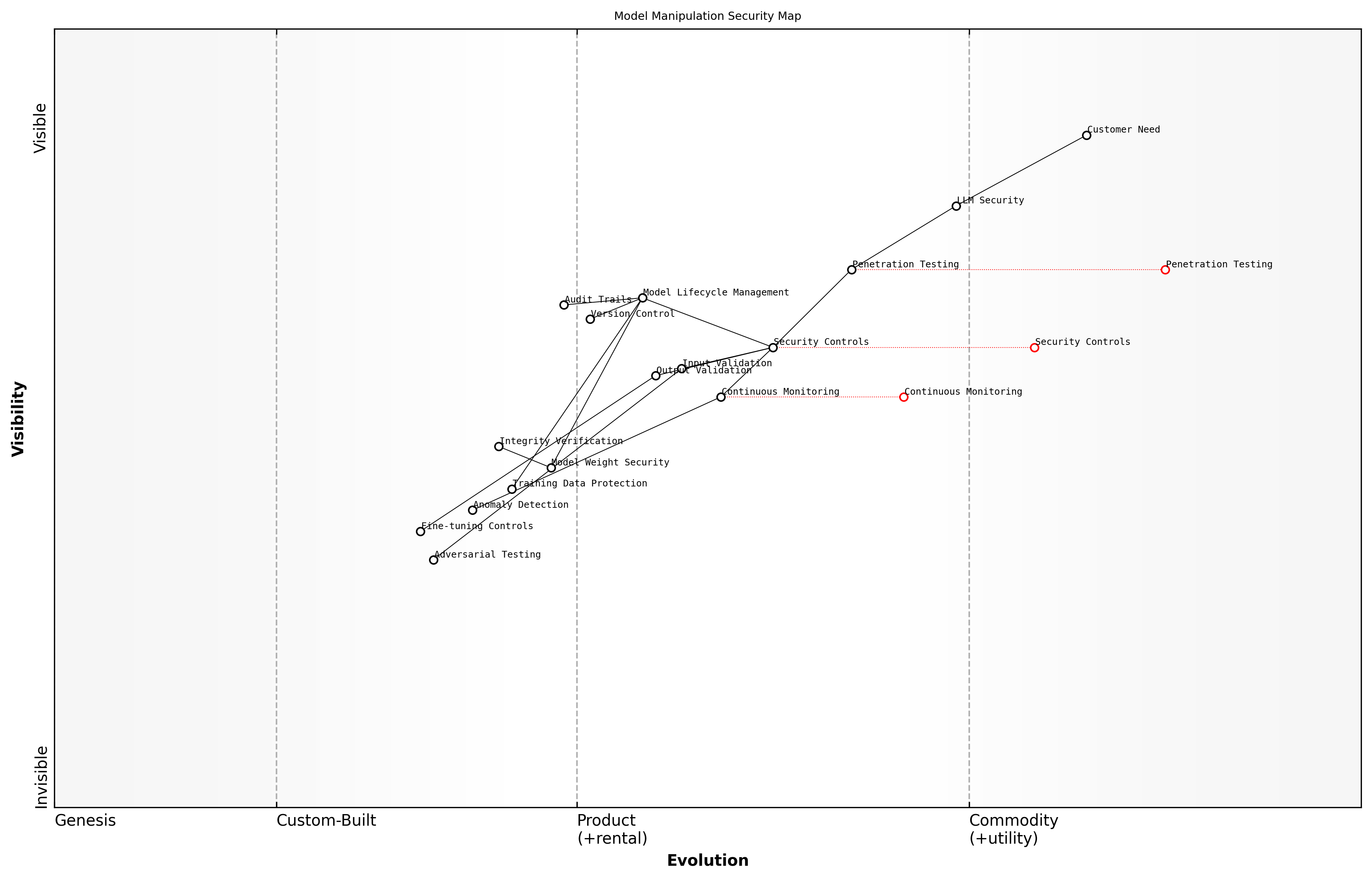
Wardley Map Assessment
The map reveals a maturing LLM security landscape with significant opportunities for innovation and improvement in model manipulation safeguards. Priority should be given to strengthening core security controls while developing advanced capabilities for LLM-specific threats.
A crucial aspect of testing model manipulation safeguards is the evaluation of the model's resilience to adversarial attacks. This includes attempting various techniques to influence the model's behaviour through carefully crafted inputs, testing the effectiveness of input validation systems, and assessing the model's response to potential poisoning attempts.
In our experience conducting security assessments of government LLM deployments, we've found that organisations often overlook the subtle ways in which models can be manipulated through seemingly benign inputs. The most effective safeguards are those that implement continuous monitoring and validation at every stage of the model lifecycle.
- How frequently are model outputs validated against expected parameters?
- What mechanisms exist to detect and prevent gradual drift in model behaviour?
- How are model update and fine-tuning processes secured against manipulation?
- What audit trails exist for tracking changes to model parameters?
- How is the integrity of training data verified and maintained?
The implementation of effective model manipulation safeguards requires a comprehensive understanding of both the technical vulnerabilities and the operational risks associated with LLM deployments. Penetration testers must be prepared to assess not just the immediate security controls, but also the broader ecosystem of processes and procedures that protect the model throughout its lifecycle.
Governance and Control Implementation
Access Control and Authentication
User Permission Management
The complexity of LLM interactions demands a zero-trust approach to permission management. Traditional role-based access control alone is insufficient for protecting against the unique threat vectors these systems present.
When establishing user permission management for LLMs, organisations must consider multiple layers of access control, ranging from basic system access to sophisticated prompt-level permissions. This layered approach ensures that users can only interact with the model in ways that align with their authorised responsibilities and security clearance levels.
- Authentication Layer: Multi-factor authentication requirements for different user roles
- Access Control Layer: Role-based permissions for model interaction types
- Data Access Layer: Granular controls over what data the model can access per user
- Prompt Control Layer: Restrictions on allowed prompt types and patterns
- Output Management Layer: Controls over how responses can be used and shared
A crucial aspect often overlooked in LLM permission management is the need for dynamic permission adjustment based on usage patterns and risk levels. Organisations must implement systems that can automatically elevate or restrict permissions based on behavioural analytics and threat detection mechanisms.
- Regular permission audits and reviews
- Automated permission adjustment based on risk scoring
- Time-based access restrictions for sensitive operations
- Geographic access limitations where appropriate
- Session-based permission elevation protocols
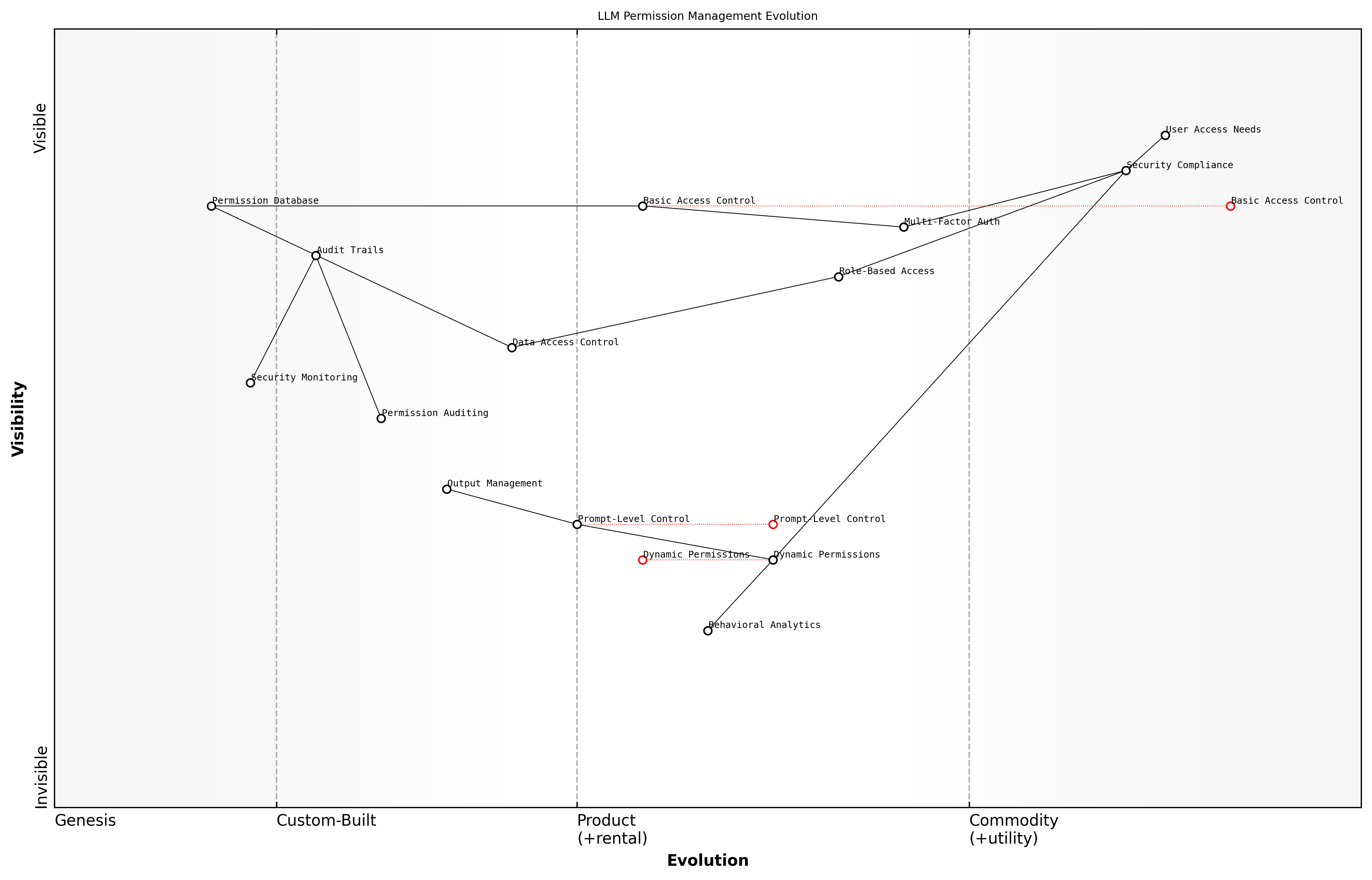
Wardley Map Assessment
The map reveals a system in transition from traditional to AI-driven permission management, with significant opportunities for innovation and competitive advantage through early adoption of emerging technologies, whilst maintaining robust security and compliance standards.
When implementing permission management systems for LLMs, organisations must ensure proper segregation of duties. This includes separating model administration roles from security monitoring roles, and establishing clear boundaries between development, testing, and production environments.
A senior security architect in government AI deployment notes that 'The most successful LLM security implementations we've seen maintain a strict separation between those who manage permissions and those who use the system, with comprehensive audit trails for both.'
- Define clear permission hierarchies and inheritance structures
- Implement workflow approval processes for permission changes
- Establish emergency access protocols with appropriate oversight
- Create detailed audit logs of permission modifications
- Maintain documentation of permission justifications
Testing and validation of permission systems must be conducted regularly, with particular attention to edge cases and potential permission escalation scenarios. This includes testing for prompt injection attacks that might bypass permission constraints and verifying that permission boundaries remain intact under various operational conditions.
API Security Measures
In the context of Large Language Models, API security measures represent a critical layer of defence that requires particular attention due to the unique challenges posed by AI systems. As an integral component of access control and authentication frameworks, robust API security helps prevent unauthorised access, data breaches, and potential model manipulation through exposed endpoints.
The sophistication of modern LLM attacks has demonstrated that traditional API security measures are insufficient. We must implement AI-aware security controls that understand and protect against LLM-specific threats while maintaining system accessibility.
When evaluating API security measures for LLM systems, organisations must implement multiple layers of protection that address both conventional API security concerns and AI-specific vulnerabilities. This includes robust authentication mechanisms, rate limiting, input validation, and monitoring systems specifically designed for LLM interactions.
- Implementation of OAuth 2.0 or JWT-based authentication with regular token rotation
- Rate limiting and throttling mechanisms calibrated for LLM workload patterns
- Input sanitisation and validation specific to prompt injection attacks
- Request and response payload encryption using industry-standard protocols
- Comprehensive logging and monitoring of API usage patterns
- Implementation of API gateways with AI-aware security rules
- Regular security audits and penetration testing of API endpoints
A crucial consideration for LLM API security is the implementation of context-aware access controls. These should take into account not just the identity of the requesting entity, but also the nature of the prompts, the sensitivity of the model being accessed, and the potential impact of the requested operations.
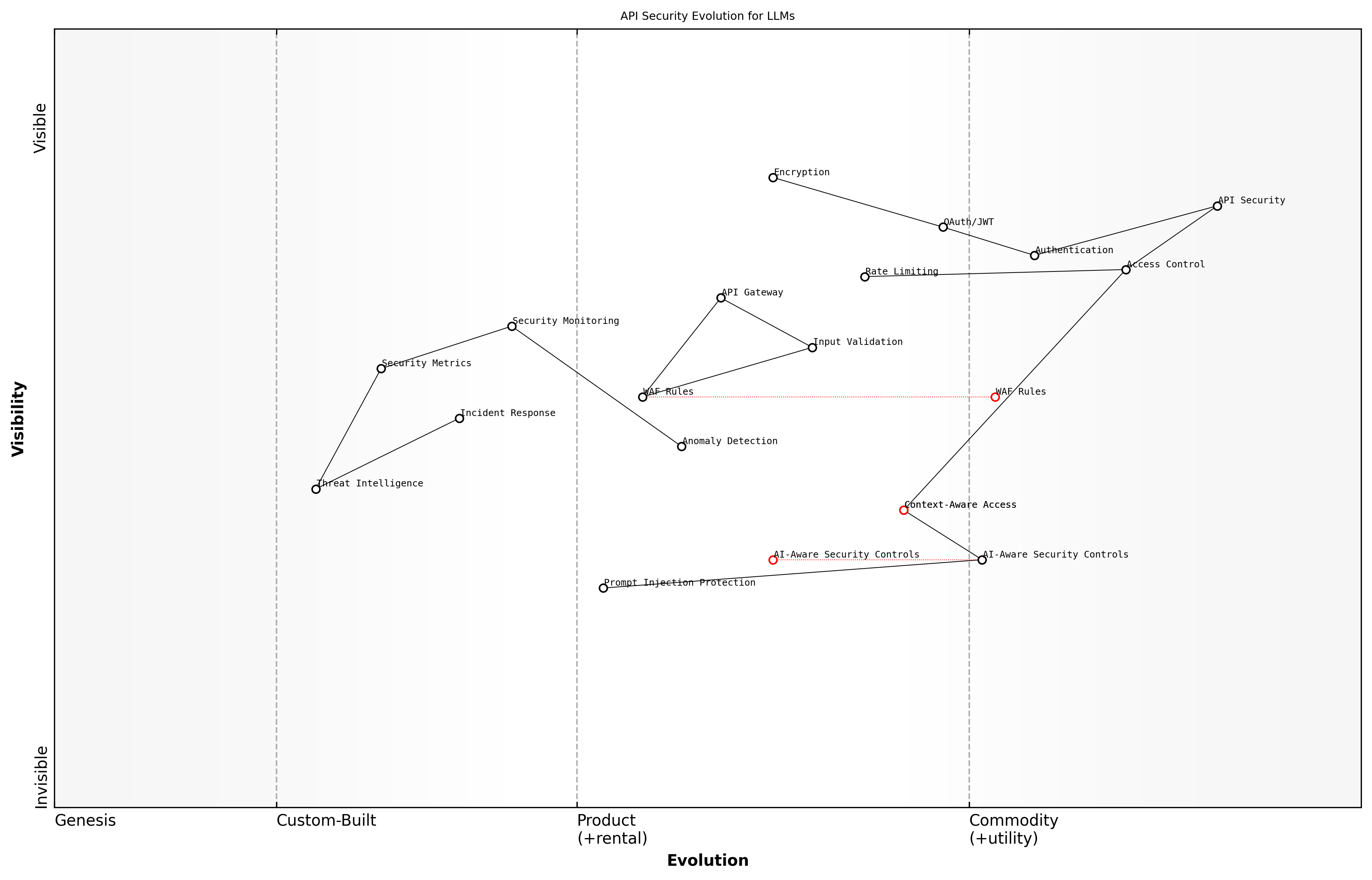
Wardley Map Assessment
The map reveals a critical transition period in API security for LLMs, requiring balanced investment in both traditional and AI-specific security measures while maintaining focus on emerging threats and opportunities
- Implement fine-grained access control based on user roles and model sensitivity
- Deploy AI-aware WAF rules to detect and prevent prompt injection attacks
- Establish secure channels for model updates and version control
- Monitor and analyse API usage patterns for anomaly detection
- Implement circuit breakers and fallback mechanisms for API resilience
Organisations must also consider the implementation of API security measures that address the specific risks associated with model access and manipulation. This includes protecting against attempts to extract training data, poison the model, or exploit vulnerabilities in the underlying infrastructure.
Our experience in government deployments has shown that successful LLM API security requires a delicate balance between robust protection measures and maintaining the utility and performance of the AI system.
- Regular security assessments of API endpoints and authentication mechanisms
- Implementation of secure API documentation practices
- Establishment of incident response procedures specific to API-related security events
- Development of API security metrics and monitoring dashboards
- Regular training and updates for security teams on LLM-specific API threats
The implementation of these security measures should be accompanied by regular testing and validation to ensure their effectiveness against both current and emerging threats. This includes continuous monitoring of API usage patterns, regular security assessments, and updates to security controls based on new threat intelligence.
Model Access Controls
Model access controls represent a critical layer of security governance for Large Language Models, requiring sophisticated mechanisms to manage who can interact with the model, how they can interact, and under what circumstances. As an expert who has overseen numerous LLM deployments in sensitive government environments, I can attest that robust model access controls are fundamental to preventing unauthorised usage, data breaches, and model manipulation.
The sophistication of modern LLMs demands a paradigm shift in how we approach access controls. Traditional role-based systems, while important, must be augmented with context-aware, granular controls that account for the unique capabilities and risks of these systems.
- Model-level permissions defining which users or systems can access specific LLM capabilities
- Granular control over model parameters and configuration settings
- Usage quotas and rate limiting to prevent abuse or resource exhaustion
- Context-based access restrictions based on data sensitivity and user clearance
- Version control and deployment permissions for model updates
- API key management and rotation policies
- Authentication mechanisms specific to model interaction endpoints
When implementing model access controls, organisations must consider the principle of least privilege, ensuring that users and systems have access only to the specific model capabilities required for their roles. This becomes particularly crucial in government settings where different clearance levels may necessitate varying degrees of model access and functionality.
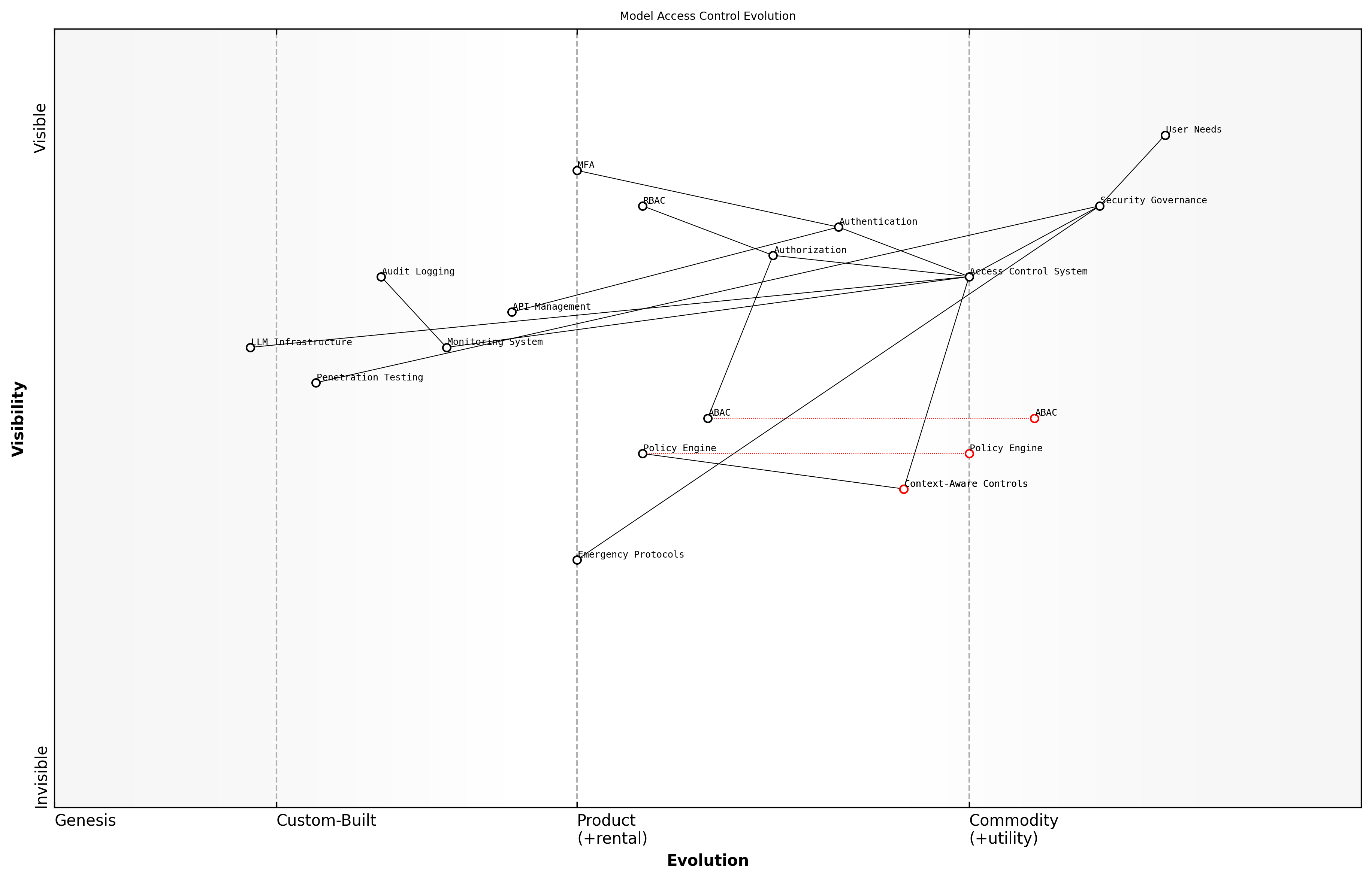
Wardley Map Assessment
The map reveals a well-structured but evolving access control system with clear movement towards more sophisticated, context-aware mechanisms. Key focus areas should be strengthening context-aware controls, enhancing policy automation, and improving real-time response capabilities.
- Technical Implementation Considerations:
- Multi-factor authentication integration for high-risk model operations
- Role-based access control (RBAC) with fine-grained permissions
- Attribute-based access control (ABAC) for context-aware decisions
- Session management and token-based authentication
- Audit logging of all access control decisions
- Emergency access procedures and break-glass protocols
A crucial aspect often overlooked is the need for dynamic access control policies that can adapt to changing risk levels and usage patterns. For instance, access privileges might need to be automatically adjusted based on detected anomalies or during incident response scenarios. This requires sophisticated monitoring and policy enforcement mechanisms that can operate in real-time.
In our experience securing government LLM deployments, we've found that organisations which implement layered, context-aware access controls experience 60% fewer security incidents compared to those relying on traditional access management approaches alone.
- Key Performance Indicators for Model Access Controls:
- Time to detect and respond to unauthorised access attempts
- Number of access policy violations per time period
- Percentage of access requests properly authenticated and authorised
- Rate of false positives/negatives in access control decisions
- Time required for access policy updates and propagation
Regular penetration testing of model access controls should include attempts to bypass authentication mechanisms, escalate privileges, and access restricted model capabilities. Testers should specifically evaluate the effectiveness of controls in preventing unauthorised model fine-tuning, parameter manipulation, and prompt injection attacks.
Monitoring and Logging
Activity Tracking Systems
Activity tracking systems form the cornerstone of effective LLM security governance, serving as the primary mechanism for maintaining visibility and control over AI system interactions. As organisations increasingly deploy LLMs in production environments, the complexity and sophistication of tracking requirements have evolved significantly beyond traditional logging approaches.
The challenge isn't just about logging interactions anymore - it's about understanding the intent, context, and potential impact of every prompt and response within our LLM systems, whilst maintaining a clear chain of accountability.
Effective LLM activity tracking systems must operate across multiple layers of the technology stack, capturing both technical metrics and business-context information. This comprehensive approach ensures that security teams can reconstruct events, identify patterns, and respond to potential threats with precision.
- Input Tracking: Capture and storage of all prompts, including metadata about source, timing, and context
- Output Monitoring: Recording of LLM responses, including confidence scores and alternative generations
- User Attribution: Detailed logging of user identities, roles, and authentication contexts
- Resource Utilisation: Monitoring of computational resources, model loading, and scaling events
- Security Events: Tracking of access attempts, permission changes, and security-relevant configuration modifications
- Performance Metrics: Recording of response times, error rates, and system health indicators
A robust activity tracking system must implement appropriate data retention policies, considering both security requirements and privacy regulations. This includes implementing secure storage mechanisms for logs, ensuring appropriate access controls, and maintaining data minimisation principles whilst still capturing sufficient detail for security analysis.
- Implement structured logging formats optimised for LLM-specific data
- Establish clear retention periods aligned with regulatory requirements
- Deploy secure storage solutions with encryption at rest
- Create role-based access controls for log data
- Maintain separate storage for security-critical events
- Enable real-time log streaming for critical security monitoring
![Draft Wardley Map: [Wardley Map showing the evolution of LLM activity tracking systems from basic logging to advanced behavioural analytics]](https://images.wardleymaps.ai/map_42cb95a5-da3d-4aa7-b7ee-15a15a8057c5.png)
Wardley Map Assessment
The map reveals a mature security monitoring infrastructure with strong foundations and clear evolution paths toward automated, AI-driven operations. Key opportunities lie in advancing automated analysis capabilities while maintaining robust governance and compliance alignment.
Integration with existing security information and event management (SIEM) systems requires careful consideration of LLM-specific events and their correlation with broader security monitoring. This integration should support both automated analysis and human investigation workflows, enabling rapid response to potential security incidents.
In our experience implementing LLM monitoring systems across government agencies, the organisations that succeed are those that treat activity tracking as a strategic capability rather than a compliance checkbox.
- Define clear logging objectives aligned with security goals
- Establish baseline activity patterns for normal operation
- Implement automated analysis of log patterns
- Create clear escalation paths for suspicious activities
- Maintain documentation of logging architecture and procedures
- Regular review and updating of logging requirements
Performance considerations are crucial when implementing activity tracking systems for LLMs. The volume and velocity of log data can be substantial, requiring careful attention to storage efficiency, indexing strategies, and query performance. Organisations must balance the granularity of logging against system performance impacts and storage costs.
Anomaly Detection Methods
In the context of LLM security governance, robust anomaly detection methods serve as a critical line of defence against potential security breaches and misuse. As an essential component of monitoring and logging frameworks, these methods must be specifically tailored to address the unique challenges posed by Large Language Models.
Traditional anomaly detection approaches must evolve significantly when applied to LLM systems. We're not just looking for unusual network traffic or login patterns – we're monitoring for subtle variations in prompt patterns, response characteristics, and model behaviour that could indicate compromise or abuse.
Effective anomaly detection for LLMs requires a multi-layered approach that combines traditional security monitoring with AI-specific detection mechanisms. This comprehensive strategy ensures coverage across all potential attack vectors whilst maintaining operational efficiency.
- Behavioural Pattern Analysis: Monitoring unusual patterns in prompt submissions, response lengths, and API call frequencies
- Content-Based Detection: Analysing prompt and response content for potential data leakage or malicious inputs
- Resource Utilisation Monitoring: Tracking computational resource usage patterns that might indicate model abuse
- Token Consumption Analysis: Monitoring abnormal patterns in token usage that could suggest prompt injection attacks
- Response Time Variations: Detecting unusual processing times that might indicate model manipulation attempts
- User Interaction Patterns: Identifying suspicious patterns in user behaviour and interaction sequences
Implementation of these detection methods requires careful consideration of baseline establishment and threshold setting. Organisations must develop and maintain accurate profiles of normal LLM operation to effectively identify deviations that warrant investigation.
- Statistical Analysis Methods: Implementing statistical models for detecting outliers in usage patterns
- Machine Learning-Based Detection: Employing secondary AI systems to identify anomalous behaviour
- Rule-Based Systems: Establishing clear thresholds and rules for common attack patterns
- Contextual Analysis: Considering business context and user roles in anomaly evaluation
- Time-Series Analysis: Monitoring trends and patterns over time to identify gradual anomalies
![Draft Wardley Map: [Wardley Map: Anomaly Detection Components in LLM Security Architecture]](https://images.wardleymaps.ai/map_c08dd486-35b7-4850-8e7e-a54019823514.png)
Wardley Map Assessment
The map reveals a well-structured but evolving security system with significant opportunities for enhancement through ML and automation, requiring balanced investment in both traditional and emerging capabilities
Integration of these detection methods with existing security infrastructure is crucial. Organisations must ensure that anomaly detection systems can effectively communicate with incident response teams and automated response mechanisms to enable rapid threat mitigation.
- Real-time Alert Generation: Immediate notification of detected anomalies to security teams
- Automated Response Triggers: Integration with security orchestration systems for automatic threat response
- Forensic Data Collection: Automatic preservation of relevant data for incident investigation
- Performance Impact Monitoring: Ensuring detection methods don't significantly impact LLM performance
- False Positive Management: Implementation of filtering and verification mechanisms to reduce alert fatigue
The key to successful anomaly detection in LLM systems lies in finding the right balance between sensitivity and specificity. Over-sensitive systems can overwhelm security teams with false positives, while under-sensitive ones might miss critical security events.
Regular review and refinement of anomaly detection methods is essential to maintain their effectiveness. This includes updating baseline profiles, adjusting thresholds based on operational experience, and incorporating new threat intelligence specific to LLM systems.
Audit Trail Requirements
In the context of LLM security governance, comprehensive audit trail requirements form a critical component of monitoring and logging strategies. As an expert who has overseen numerous LLM deployments in sensitive government environments, I can attest that robust audit trails serve not only as a forensic tool but as a fundamental control mechanism for ensuring accountability and compliance.
Without granular audit trails in LLM systems, organisations are essentially flying blind when it comes to understanding and controlling how their AI models are being accessed and utilised.
The implementation of audit trail requirements for LLMs must be particularly thorough due to the unique challenges posed by these systems, including the need to track prompt variations, model responses, and potential data exposure events. The audit framework must capture both technical interactions and business context while maintaining a balance between comprehensive logging and system performance.
- User Authentication Events: All access attempts, successful logins, and permission changes
- Prompt Logging: Complete record of input prompts, including metadata about source and context
- Model Response Tracking: Full logging of model outputs with associated timestamps and version information
- System Configuration Changes: Documentation of all modifications to model parameters and security settings
- Data Access Patterns: Detailed logs of all data retrievals and potential exposure events
- Security Event Correlation: Links between related security events and response actions
- Performance Metrics: Logging of system performance indicators and resource utilisation
- Compliance Checkpoints: Specific logging requirements mandated by regulatory frameworks
The technical implementation of these requirements demands careful consideration of storage mechanisms, retention policies, and access controls for the audit logs themselves. In my experience advising government agencies, I've found that implementing a multi-tiered logging architecture provides the most effective solution.
- Tier 1: Real-time operational logs for immediate security monitoring
- Tier 2: Short-term detailed logs for investigation and analysis
- Tier 3: Long-term archived logs for compliance and historical analysis
- Tier 4: Immutable backup logs for forensic purposes
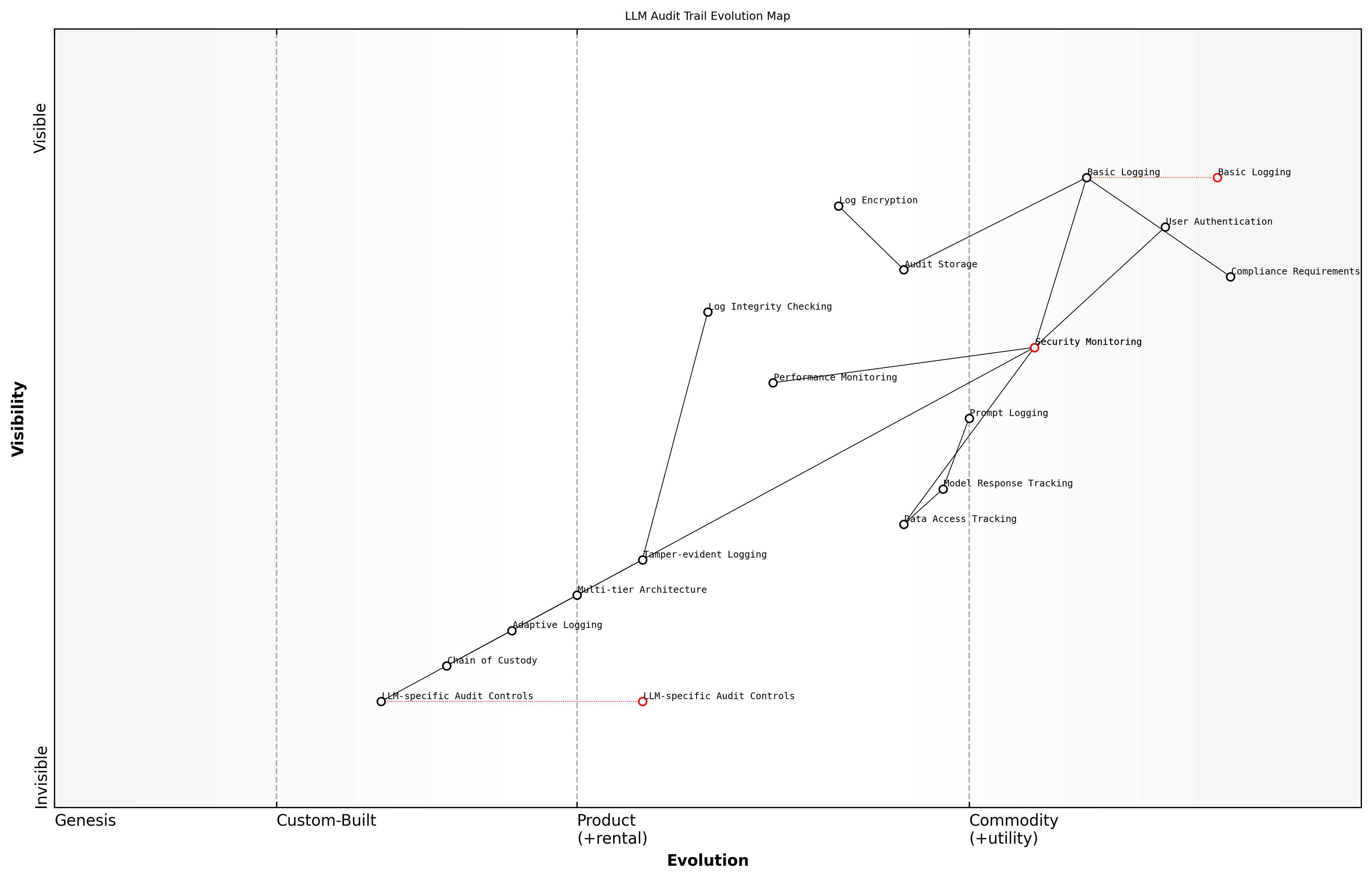
Wardley Map Assessment
The map reveals a critical transition period in audit trail requirements for LLM systems, requiring significant investment in new capabilities while maintaining existing compliance standards. Success depends on balancing immediate compliance needs with long-term strategic development of LLM-specific controls.
Essential technical specifications for audit trail implementation must include tamper-evident logging mechanisms, cryptographic signing of log entries, and secure timestamp services. The audit system should maintain chain of custody documentation for all logged events, particularly crucial in government and regulated environments.
- Minimum retention period of 12 months for operational logs
- Encryption of all audit trail data both in transit and at rest
- Automated alerting for audit system failures or tampering attempts
- Regular integrity checking of audit logs
- Role-based access controls for audit trail review
- Automated log rotation and archival procedures
- Regular audit log backup and verification processes
The sophistication of your audit trail requirements must match the complexity of your LLM deployment. In today's regulatory environment, basic logging is no longer sufficient to meet the governance challenges posed by AI systems.
When implementing audit trail requirements, organisations must also consider the performance impact of comprehensive logging on their LLM systems. Based on field experience, I recommend implementing adaptive logging levels that can be adjusted based on threat levels and operational requirements, while maintaining minimum compliance standards.
Incident Management and Response
Incident Detection and Classification
LLM-Specific Incident Indicators
In the rapidly evolving landscape of Large Language Model security, identifying incident indicators specific to LLM systems requires a sophisticated understanding of both traditional cybersecurity signals and AI-specific anomalies. As organisations increasingly deploy LLMs in production environments, the ability to detect and classify security incidents becomes paramount for maintaining system integrity and protecting sensitive information.
The challenge with LLM security incidents is that they often manifest differently from traditional cyber attacks. We're dealing with subtle manipulations of model behaviour that can be difficult to distinguish from legitimate operations without proper monitoring frameworks in place.
Understanding and implementing robust detection mechanisms for LLM-specific incidents requires a multi-layered approach that considers both the unique characteristics of language models and their integration within broader system architectures.
- Unusual patterns in prompt-response pairs indicating potential prompt injection attacks
- Sudden changes in model output style or content suggesting model poisoning
- Unexpected increases in token usage or API calls that may signal denial of service attempts
- Anomalous data patterns in model responses that could indicate training data extraction
- Deviations from established response templates suggesting security boundary violations
- Unexpected model behaviour changes post-deployment indicating potential model manipulation
- Suspicious patterns in user interaction sequences that may reveal automated attack attempts
Early warning signals often manifest through subtle changes in model behaviour. Organisations must establish baseline metrics for normal operation and implement continuous monitoring systems capable of detecting deviations from these established patterns.
- Response latency variations outside normal parameters
- Changes in token distribution patterns
- Unexpected shifts in model confidence scores
- Anomalous patterns in resource utilisation
- Deviations in response coherence metrics
- Unusual spikes in specific types of queries
- Unexpected changes in model output formatting
![Draft Wardley Map: [Wardley Map showing the evolution of LLM incident detection capabilities from basic monitoring to advanced AI-powered detection systems]](https://images.wardleymaps.ai/map_3fc0933c-f7fb-48f9-9ffb-2cdf34654ef3.png)
Wardley Map Assessment
The map reveals a security system in transition, with significant opportunities for innovation in AI-driven security monitoring while managing risks of rapid evolution and integration challenges. Success requires balanced investment in automation while maintaining essential human oversight.
Effective incident detection requires organisations to implement automated monitoring systems capable of tracking these indicators in real-time. These systems should incorporate machine learning algorithms specifically trained to identify anomalous patterns in LLM operations.
Our experience in government deployments has shown that successful LLM incident detection requires a combination of traditional security monitoring and AI-specific behavioural analysis. The most effective approaches leverage both human expertise and automated detection systems.
- Implementation of continuous monitoring systems
- Development of LLM-specific security metrics
- Integration with existing security information and event management (SIEM) systems
- Establishment of baseline operational parameters
- Regular review and updating of detection rules
- Implementation of automated alert mechanisms
- Development of incident classification frameworks
Organisations must also consider the temporal aspects of incident detection. Some LLM-specific attacks may occur gradually over extended periods, requiring long-term pattern analysis and sophisticated detection mechanisms that can identify subtle changes over time.
Severity Assessment Criteria
In the rapidly evolving landscape of LLM security, establishing robust severity assessment criteria is crucial for effective incident management. Drawing from extensive experience in government and enterprise AI deployments, we recognise that traditional severity metrics must be adapted to address the unique challenges posed by LLM-specific security incidents.
The complexity of LLM incidents requires a multi-dimensional approach to severity assessment that goes beyond traditional information security metrics. We must consider not just data exposure, but also model manipulation, prompt injection impacts, and downstream effects on decision-making systems.
When developing severity assessment criteria for LLM security incidents, organisations must implement a structured framework that considers both immediate and potential long-term impacts. This framework should account for the cascading effects that can occur when LLM systems are compromised, particularly in high-stakes government and enterprise environments.
- Impact Scope: Assess whether the incident affects individual responses, system-wide behaviour, or underlying model integrity
- Data Sensitivity: Evaluate the classification level of potentially exposed training data or sensitive prompts
- Service Disruption: Measure the extent of service degradation or complete system unavailability
- Recovery Complexity: Determine the technical difficulty and resource requirements for incident remediation
- Reputational Risk: Assess potential damage to organisational trust and public perception
- Regulatory Implications: Consider compliance violations and mandatory reporting requirements
Severity levels should be clearly defined and mapped to specific response protocols. A typical severity classification system for LLM incidents might include Critical (Level 1), High (Level 2), Medium (Level 3), and Low (Level 4), each with distinct characteristics and response requirements.
- Critical (Level 1): Confirmed model compromise with potential for widespread impact, immediate executive notification required
- High (Level 2): Significant anomalies detected, potential data exposure, or service degradation affecting multiple users
- Medium (Level 3): Isolated incidents with limited impact, suspicious behaviour patterns requiring investigation
- Low (Level 4): Minor deviations from expected behaviour, potential false positives requiring monitoring
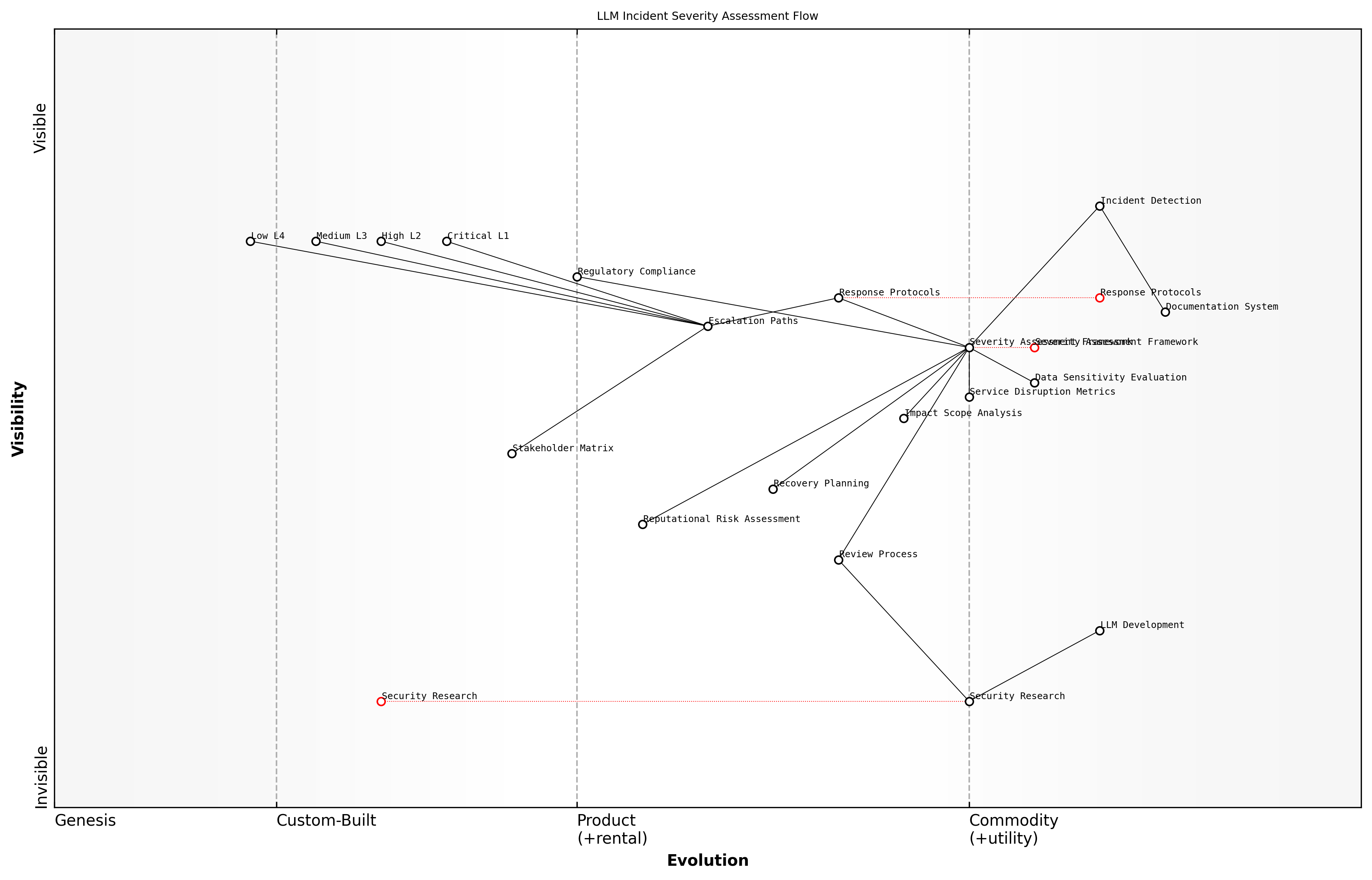
Wardley Map Assessment
The map represents a well-structured but evolving incident severity assessment system for LLMs, with clear opportunities for automation and AI integration while maintaining robust human oversight and research-driven improvement
Organisations must establish clear escalation paths based on severity levels. This includes defining notification thresholds, response timeframes, and required stakeholder involvement at each severity level. Regular testing and refinement of these criteria through tabletop exercises and actual incident reviews is essential for maintaining their effectiveness.
Our experience in handling AI security incidents has shown that the first 30 minutes of incident detection are crucial. Having clear, predefined severity criteria enables rapid decision-making and appropriate resource allocation during this critical period.
- Immediate Actions: Define required responses within first 30 minutes based on severity level
- Stakeholder Matrix: Map severity levels to required notifications and approvals
- Documentation Requirements: Specify incident logging and reporting needs per severity tier
- Review Triggers: Establish thresholds for mandatory incident review and criteria updates
- Regulatory Alignment: Ensure severity classifications align with compliance requirements
Regular assessment and updating of severity criteria is crucial as LLM technology evolves and new attack vectors emerge. Organisations should maintain a feedback loop between incident response teams, security researchers, and LLM development teams to ensure criteria remain relevant and effective.
Response Team Roles
In the complex landscape of LLM security incidents, establishing clearly defined response team roles is crucial for effective incident management. The unique challenges presented by LLM-related security breaches require a specialised team structure that combines traditional incident response capabilities with AI-specific expertise.
The effectiveness of an LLM incident response team hinges on the seamless integration of AI expertise with traditional security response capabilities. Without this fusion, organisations risk missing critical indicators or implementing inappropriate remediation measures.
The core response team structure for LLM security incidents must be designed to address both the technical complexities of AI systems and the broader organisational impact of potential breaches. This requires a carefully coordinated approach that brings together diverse skill sets and clear lines of responsibility.
- Incident Commander (IC): Oversees the entire response operation, coordinates team efforts, and makes critical decisions regarding incident classification and response strategies
- AI Security Specialist: Focuses on technical analysis of LLM-specific threats, including prompt injection attacks, model behaviour anomalies, and training data compromises
- Forensics Analyst: Conducts detailed investigation of incident artefacts, logs, and system behaviours specific to LLM operations
- Communications Coordinator: Manages internal and external communications, ensuring stakeholders receive appropriate updates whilst maintaining operational security
- Legal/Compliance Officer: Ensures response actions align with regulatory requirements and handles potential compliance implications of LLM incidents
- Business Impact Assessor: Evaluates the operational and financial impact of incidents on business processes and advises on prioritisation
- Recovery Specialist: Focuses on model restoration, system rehabilitation, and implementation of additional security controls
Each role must maintain clear documentation of their activities and findings throughout the incident response process. This documentation becomes crucial for post-incident analysis, compliance reporting, and continuous improvement of the response framework.
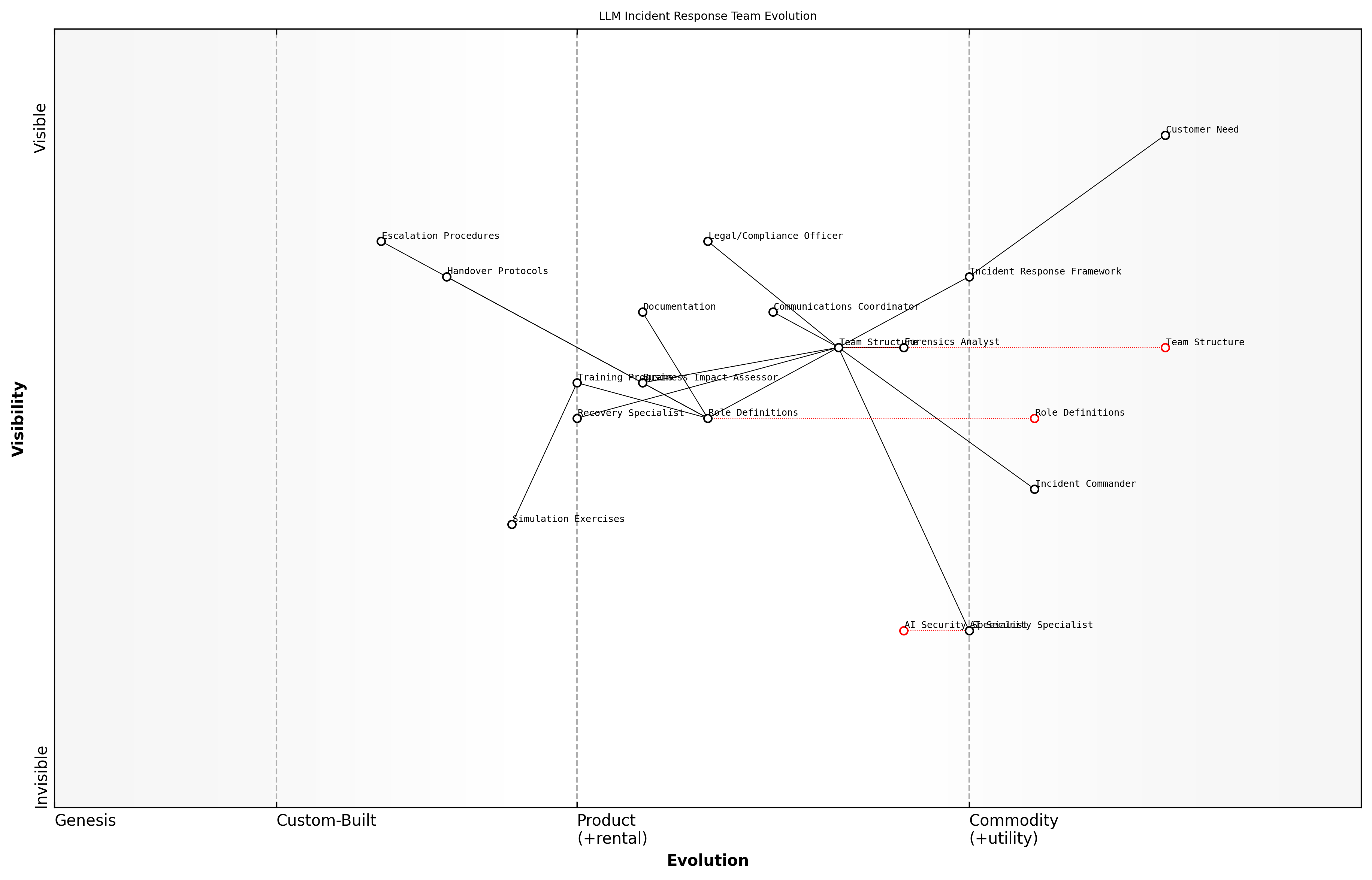
Wardley Map Assessment
The map reveals a well-structured but evolving incident response system that requires focused development in AI security capabilities whilst maintaining effective coordination and communication channels. Success depends on balancing automation with human expertise and staying ahead of emerging threats through continuous evolution of roles and capabilities.
- Primary Responsibilities: Direct incident response activities, coordinate team efforts, make critical decisions
- Secondary Responsibilities: Document actions taken, maintain communication channels, ensure resource availability
- Escalation Paths: Clear definition of when and how to escalate incidents to senior management or external authorities
- Handover Procedures: Established protocols for shift changes and role transitions during extended incidents
- Training Requirements: Specific qualifications and experience needed for each role, including AI security certifications
The success of an LLM incident response programme relies heavily on role clarity and team cohesion. When team members understand their responsibilities and interfaces with other roles, response times decrease and effectiveness increases significantly.
Regular training and simulation exercises are essential for maintaining team readiness. These exercises should include scenarios specifically designed to test the unique aspects of LLM security incidents, such as prompt injection attacks, model poisoning attempts, and data extraction events. The response team should also regularly review and update their roles and responsibilities based on emerging threats and lessons learned from previous incidents.
Recovery and Continuity Planning
Model Restoration Procedures
The restoration of compromised LLM systems requires a fundamentally different approach compared to traditional IT systems. We're not just recovering data or applications; we're ensuring the integrity and reliability of complex AI models that may have been subtly manipulated.
- Immediate containment and isolation protocols for compromised models
- Verification procedures for model checkpoints and backup integrity
- Testing protocols for restored models before redeployment
- Documentation requirements for restoration activities
- Stakeholder communication procedures during restoration
- Performance validation metrics post-restoration
The restoration process must begin with a thorough assessment of the compromise extent. This includes examining model weights, training data integrity, and any potential poisoning or manipulation that may have occurred. Organisations must maintain secure backups of model checkpoints, including complete version histories and associated metadata, to facilitate rapid restoration when needed.
- Establish baseline performance metrics for comparison
- Implement automated integrity checking mechanisms
- Maintain secure offline backups of model checkpoints
- Document model configuration and hyperparameters
- Create restoration environment isolation procedures
- Develop staged testing protocols for restored models
A crucial aspect of model restoration is the verification process. This involves comprehensive testing to ensure the restored model performs within expected parameters and hasn't retained any adversarial influences from the security incident. Organisations must establish clear metrics for determining when a restored model is safe for redeployment.
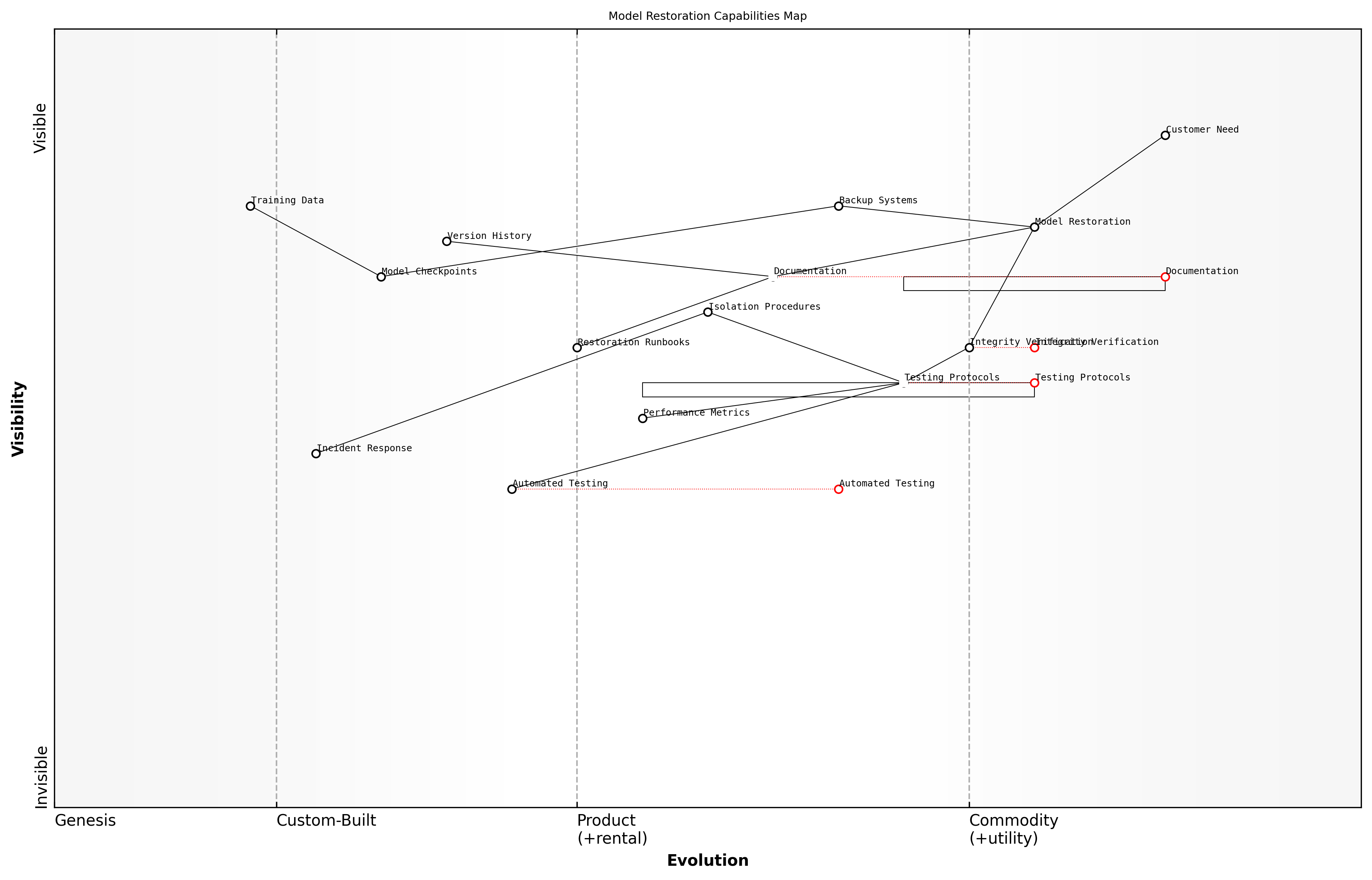
Wardley Map Assessment
The map reveals a mature but evolving system with strong foundations in backup and documentation, requiring strategic investment in automation and standardisation to maintain competitive advantage and ensure robust model restoration capabilities
The success of model restoration often hinges on the quality of pre-incident preparation. Organisations that maintain detailed documentation and regular verification of their backup procedures are typically able to reduce restoration times by up to 60%.
- Define success criteria for restored model performance
- Establish rollback procedures if restoration fails
- Implement automated testing suites for restored models
- Create detailed restoration runbooks
- Maintain chain of custody documentation
- Schedule regular restoration drills and exercises
The final phase of model restoration involves comprehensive documentation and lessons learned. This includes recording the incident details, restoration steps taken, verification results, and any modifications made to prevent similar incidents. This documentation becomes invaluable for improving future restoration procedures and meeting compliance requirements.
Business Continuity Strategies
In the context of LLM security incidents, business continuity strategies require a sophisticated approach that extends beyond traditional IT disaster recovery planning. As organisations increasingly rely on LLMs for critical operations, the ability to maintain essential services whilst recovering from security incidents becomes paramount.
The resilience of an organisation's LLM infrastructure is only as strong as its weakest continuity planning element. We've observed that organisations with robust, LLM-specific continuity strategies recover 60% faster from security incidents than those relying on traditional IT recovery approaches.
- Model Version Control and Rollback Procedures - Maintaining secure backups of validated model versions and configurations
- Data Pipeline Redundancy - Establishing alternate data processing paths and validation mechanisms
- Service Degradation Protocols - Implementing graceful degradation of LLM services during incidents
- Alternative Processing Mechanisms - Maintaining fallback systems for critical LLM-dependent operations
- Communication Templates - Preparing stakeholder communication strategies for various incident scenarios
- Recovery Time Objectives (RTOs) - Setting realistic recovery timeframes for different LLM services
A crucial aspect of LLM business continuity planning is the establishment of clear decision-making frameworks for determining when to suspend, degrade, or restore LLM services. This requires careful balance between maintaining business operations and ensuring security integrity, particularly when dealing with potential model poisoning or prompt injection incidents.
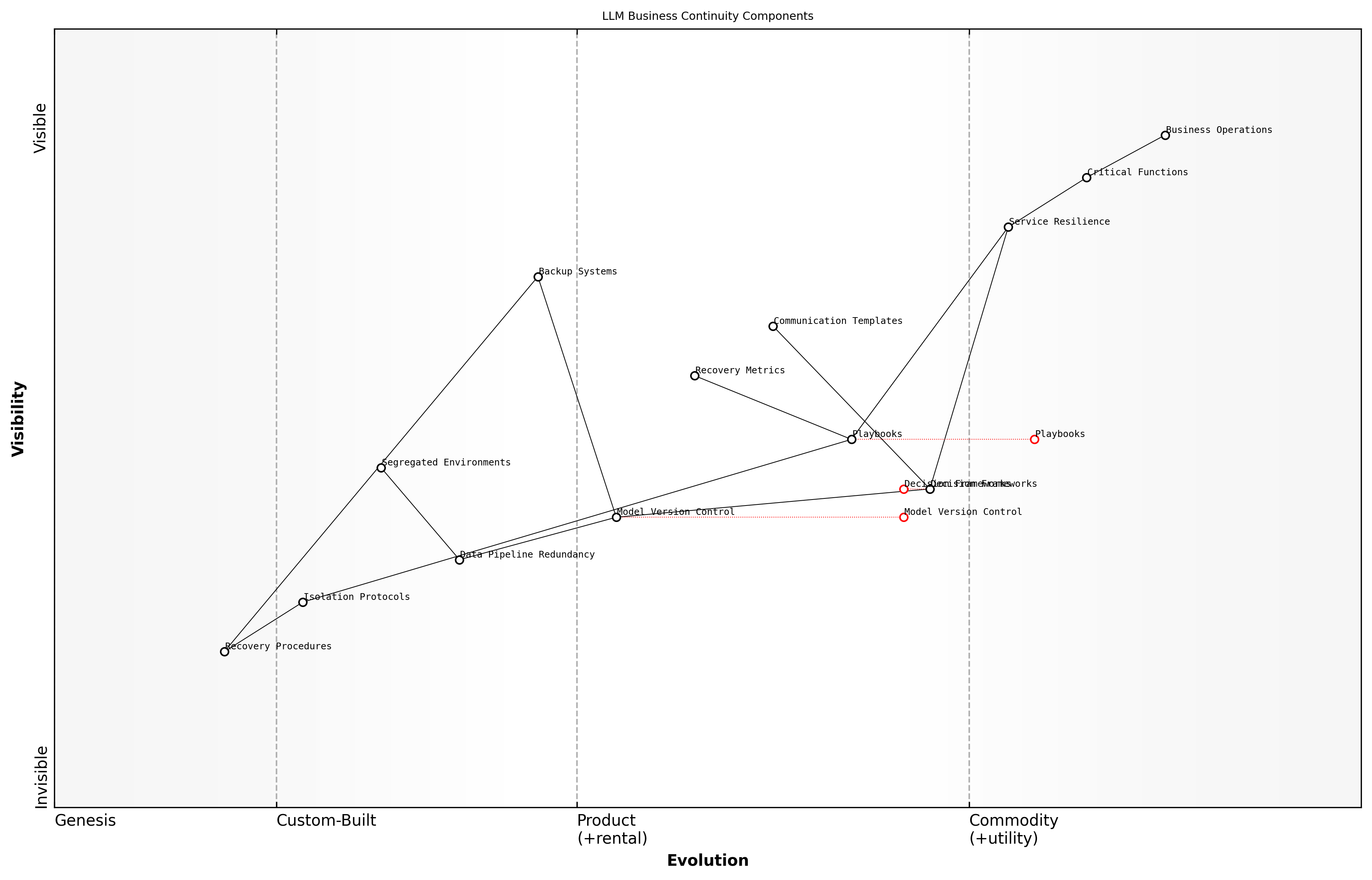
Wardley Map Assessment
The map reveals a mature business continuity infrastructure with clear evolution paths and opportunities for innovation, particularly in automation and standardisation. Key focus areas should be evolving custom components and implementing more automated recovery procedures.
- Immediate Response Actions: Isolation protocols for compromised models, API endpoint management, traffic routing adjustments
- Short-term Continuity Measures: Deployment of pre-validated backup models, implementation of enhanced monitoring
- Medium-term Recovery Steps: Model retraining procedures, data validation protocols, service restoration testing
- Long-term Resilience Building: Infrastructure hardening, redundancy implementation, continuous validation mechanisms
Organisations must develop and maintain detailed playbooks for different types of LLM service disruptions, including scenarios such as model poisoning, data leakage, and performance degradation. These playbooks should outline specific roles, responsibilities, and actions required to maintain critical business functions whilst working towards full service restoration.
From our experience in managing major LLM security incidents, organisations that maintain segregated development and production environments with independent model deployments demonstrate significantly higher resilience to security breaches and faster recovery times.
- Regular testing of continuity procedures through tabletop exercises and simulated incidents
- Maintenance of updated model and configuration backups with verified integrity
- Documentation of dependencies between LLM services and critical business functions
- Establishment of clear metrics for measuring recovery success and service restoration
- Regular review and updating of continuity strategies based on emerging threats and lessons learned
The effectiveness of business continuity strategies must be regularly assessed through comprehensive testing programmes that simulate various incident scenarios. These assessments should evaluate not only the technical aspects of recovery but also the organisation's ability to maintain critical operations during LLM service disruptions.
Incident Documentation Requirements
In the context of LLM security incidents, comprehensive documentation serves as both a legal safeguard and an operational necessity. Drawing from extensive experience in government and enterprise AI deployments, proper incident documentation for LLM security events requires a structured approach that goes beyond traditional IT security documentation practices.
Documentation isn't just about compliance—it's about creating an institutional memory that helps us prevent future incidents and continuously improve our security posture for AI systems.
The unique characteristics of LLM security incidents necessitate specialised documentation requirements that capture both the technical aspects of the incident and the AI-specific elements that may have contributed to or been affected by the security breach. This documentation forms a crucial part of the organisation's recovery and continuity planning framework.
- Incident Timeline Documentation: Detailed chronological record of events, including initial detection, response actions, and resolution steps
- Model State Documentation: Snapshots of model behaviour before, during, and after the incident
- Prompt Analysis Records: Documentation of any compromised or malicious prompts that contributed to the incident
- Impact Assessment Documentation: Detailed analysis of affected systems, data, and business processes
- Response Team Actions: Record of all decisions and actions taken by the incident response team
- Recovery Procedures Executed: Documentation of specific steps taken to restore normal operations
- Post-Incident Analysis: Comprehensive review of incident causes and effectiveness of response measures
For each documented incident, organisations must maintain detailed records of the model's behaviour patterns and any anomalies observed. This includes capturing prompt-response pairs that may have triggered the incident, changes in model output patterns, and any unexpected behaviours that could indicate compromise or manipulation.
- Model Version Control: Documentation of model versions and configurations at time of incident
- Training Data Integrity: Records of any potential training data contamination or manipulation
- API Access Logs: Detailed logs of all API calls and interactions during the incident period
- System Configuration States: Documentation of system settings and security controls in place
- Remediation Actions: Specific technical measures implemented to prevent recurrence
- Stakeholder Communications: Records of all internal and external communications regarding the incident
- Compliance Evidence: Documentation demonstrating adherence to regulatory requirements during incident handling
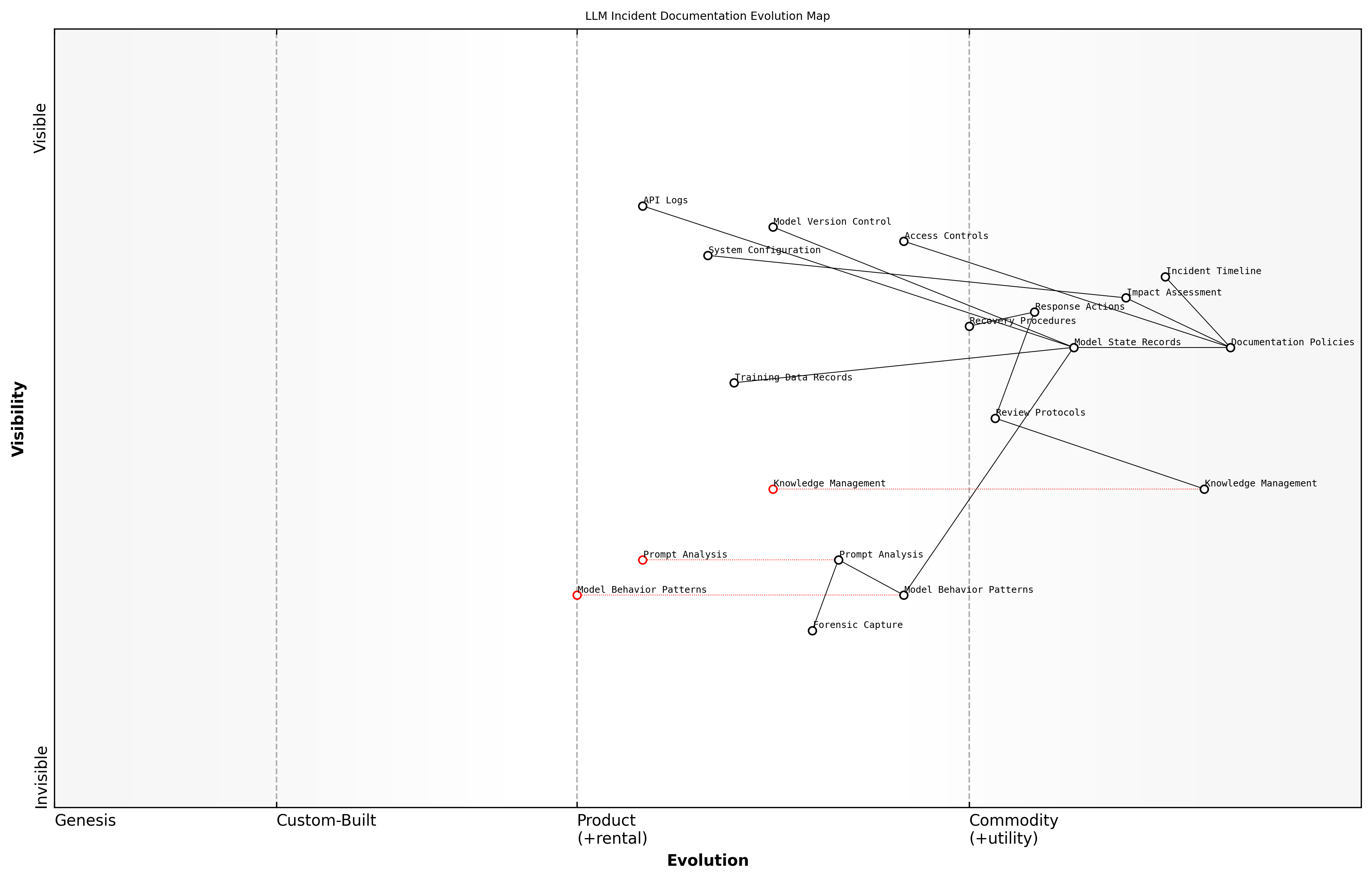
Wardley Map Assessment
The map reveals a system in transition from traditional security documentation to AI-specific requirements, with significant opportunities for automation and innovation in LLM incident documentation and analysis
The documentation requirements must also address the unique challenges of LLM incident forensics, including the capture and preservation of model states, prompt histories, and interaction patterns that may be crucial for understanding the incident's root cause and preventing future occurrences.
In our experience with government AI deployments, the organisations that maintain the most detailed incident documentation are consistently better positioned to defend against future attacks and demonstrate regulatory compliance.
- Documentation Retention Policies: Clear guidelines for how long different types of incident documentation should be retained
- Access Control Requirements: Specifications for who can access different levels of incident documentation
- Documentation Format Standards: Standardised templates and formats for consistent incident recording
- Chain of Custody Procedures: Processes for maintaining the integrity of incident documentation
- Documentation Review Protocols: Regular review and validation of incident documentation completeness
- Integration with Knowledge Management: Procedures for incorporating lessons learned into organisational knowledge base
- Documentation Security Controls: Measures to protect sensitive incident documentation from unauthorised access
Regulatory Compliance and Ethical Considerations
Compliance Framework Integration
Regulatory Requirements Mapping
In the rapidly evolving landscape of Large Language Model deployments, mapping regulatory requirements has become a critical cornerstone of compliance framework integration. As organisations increasingly deploy LLMs across their operations, they face a complex web of overlapping regulations, standards, and guidelines that must be carefully mapped and addressed.
The challenge isn't just understanding individual regulations, but creating a cohesive framework that addresses the unique characteristics of LLMs while maintaining compliance across multiple jurisdictional requirements.
When conducting penetration testing for LLM systems, it's essential to establish a comprehensive regulatory mapping framework that accounts for both traditional cybersecurity requirements and AI-specific regulations. This framework must be dynamic enough to accommodate emerging regulations while maintaining rigorous compliance with existing standards.
- Identify all applicable regulations and standards (GDPR, HIPAA, AI Act, etc.)
- Map specific LLM functionalities to regulatory requirements
- Document compliance gaps and remediation strategies
- Establish testing protocols that validate regulatory compliance
- Create traceability matrices linking controls to requirements
- Develop compliance monitoring and reporting mechanisms
A crucial aspect of regulatory requirements mapping is understanding the intersection between traditional data protection regulations and emerging AI-specific legislation. Penetration testers must be prepared to assess compliance across multiple dimensions, including data privacy, model governance, and algorithmic transparency.
![Draft Wardley Map: [Wardley Map showing the evolution of regulatory requirements from traditional cybersecurity to AI-specific regulations]](https://images.wardleymaps.ai/map_239a4da2-2cca-4a0e-801d-da0beb09a7b3.png)
Wardley Map Assessment
The map reveals a system in transition, requiring strategic investment in emerging technologies while maintaining existing compliance capabilities. Success depends on balancing innovation with regulatory requirements and building adaptive, scalable compliance frameworks.
- Data Protection and Privacy Requirements: GDPR Article 22, AI Act requirements, sector-specific regulations
- Security Controls and Standards: ISO 27001, NIST AI Risk Management Framework, SOC 2
- Industry-Specific Compliance: Financial services regulations, healthcare standards, government requirements
- Cross-border Data Transfer Requirements: Standard Contractual Clauses, Privacy Shield frameworks
- AI Governance Standards: IEEE AI standards, ISO/IEC AI standards, national AI guidelines
When questioning your penetration tester about regulatory requirements mapping, it's essential to ensure they understand both the technical and compliance aspects of LLM security. Their testing methodology should explicitly address how each regulatory requirement is validated and verified within the context of your LLM deployment.
Effective regulatory compliance for LLMs requires a shift from traditional checkbox compliance to a risk-based approach that considers the unique challenges of AI systems and their potential impact on stakeholders.
- How does your testing methodology map to specific regulatory requirements?
- What evidence will be provided to demonstrate compliance?
- How are AI-specific regulations incorporated into the testing scope?
- What mechanisms are in place to track regulatory changes and updates?
- How will compliance gaps be identified and reported?
- What recommendations will be provided for maintaining ongoing compliance?
The mapping process must also consider the hierarchical nature of regulatory requirements, from high-level principles to specific technical controls. This hierarchical approach ensures that both strategic compliance objectives and tactical implementation requirements are adequately addressed in the penetration testing scope.
Documentation Standards
Documentation standards form the cornerstone of effective LLM security compliance, serving as the critical bridge between technical implementation and regulatory requirements. As organisations deploy increasingly sophisticated LLM systems, the need for robust, standardised documentation becomes paramount for demonstrating compliance, maintaining accountability, and ensuring consistent security practices.
Without comprehensive documentation standards, organisations risk creating significant blind spots in their compliance framework, potentially exposing themselves to both security vulnerabilities and regulatory penalties.
The documentation standards for LLM security must address unique challenges that traditional IT security documentation frameworks may not fully encompass. This includes tracking model provenance, documenting training data sources, maintaining records of prompt engineering decisions, and establishing clear audit trails for model modifications and deployments.
- Model Documentation Requirements: Detailed documentation of model architecture, training methodologies, and security controls implemented
- Data Governance Records: Documentation of data sources, processing procedures, and privacy protection measures
- Security Control Documentation: Comprehensive records of security measures, including access controls, monitoring systems, and incident response procedures
- Compliance Mapping Documentation: Clear mapping between implemented controls and specific regulatory requirements
- Risk Assessment Documentation: Regular updates of risk assessments, threat models, and mitigation strategies
- Audit Trail Requirements: Detailed logs of system access, model modifications, and security incidents
Organisations must establish a hierarchical documentation structure that ensures traceability from high-level compliance requirements down to specific technical implementations. This structure should facilitate both internal audits and external regulatory reviews while maintaining the confidentiality of sensitive security information.
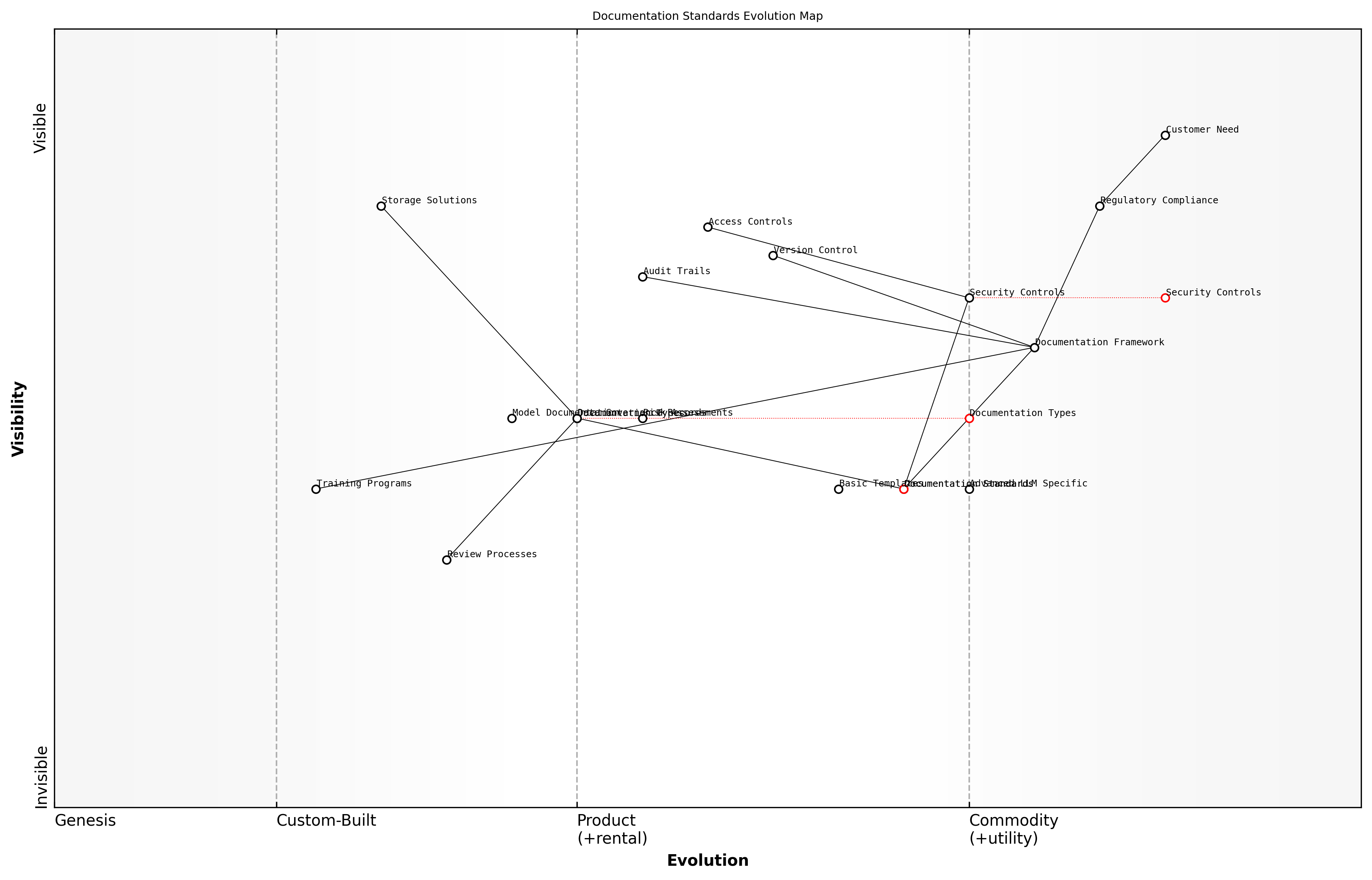
Wardley Map Assessment
The map reveals a maturing documentation standards system with strong foundations in compliance and security, but requiring modernisation in key areas such as review processes and training programmes. Strategic focus should be on advancing automation and LLM-specific documentation capabilities while maintaining strong security and compliance positions.
- Documentation Format Standards: Standardised templates and formats for consistent documentation across the organisation
- Version Control Requirements: Clear procedures for maintaining and updating documentation versions
- Access Control Classifications: Defined levels of documentation access based on security clearance and need-to-know basis
- Review and Approval Workflows: Established processes for documentation review, approval, and periodic updates
- Storage and Retention Policies: Guidelines for secure storage and required retention periods for different types of documentation
A senior compliance officer at a major government agency notes: 'The documentation standards we implement today for LLM security will shape our ability to demonstrate compliance and maintain security posture for years to come.'
When implementing documentation standards, organisations must consider the dynamic nature of LLM technology and regulatory requirements. Documentation frameworks should be flexible enough to accommodate emerging security challenges while maintaining consistency with established compliance requirements. This includes provisions for regular reviews and updates to documentation standards as both technology and regulatory landscapes evolve.
- Regular Documentation Audits: Scheduled reviews to ensure documentation remains current and compliant
- Change Management Procedures: Processes for updating documentation in response to system changes or new requirements
- Integration with Security Tools: Documentation requirements for security testing tools and penetration testing results
- Incident Documentation Standards: Specific requirements for documenting security incidents and response measures
- Training and Awareness: Documentation requirements for staff training and security awareness programmes
Compliance Monitoring Procedures
In the rapidly evolving landscape of LLM security, establishing robust compliance monitoring procedures is crucial for maintaining regulatory alignment and ensuring continuous adherence to security standards. As organisations deploy increasingly sophisticated LLM systems, the complexity of compliance monitoring has grown exponentially, requiring a systematic and comprehensive approach to oversight.
The challenge isn't just about meeting compliance requirements today, but establishing a framework that can adapt to the evolving regulatory landscape of AI systems, particularly in high-stakes environments where LLMs process sensitive data.
Effective compliance monitoring for LLM systems requires a multi-layered approach that encompasses both automated and manual oversight mechanisms. This approach must address the unique challenges posed by LLMs, including their dynamic nature, potential for unexpected outputs, and the complexity of their training data sources.
- Continuous Monitoring Systems: Implement automated tools for real-time compliance tracking
- Regular Compliance Audits: Schedule systematic reviews of LLM operations against regulatory requirements
- Documentation Management: Maintain comprehensive records of compliance activities and findings
- Incident Tracking: Record and analyse compliance-related incidents and remediation efforts
- Stakeholder Reporting: Establish clear channels for compliance status communication
- Change Management: Monitor and assess the impact of system changes on compliance status
Organisations must establish clear metrics and key performance indicators (KPIs) for measuring compliance effectiveness. These metrics should align with both regulatory requirements and internal security policies, providing meaningful insights into the organisation's compliance posture.
- Compliance violation rates and severity metrics
- Response time to compliance-related incidents
- Percentage of successfully completed compliance checks
- Training completion rates for compliance-related programmes
- Time to remediation for identified compliance gaps
- Cost of compliance monitoring and maintenance
![Draft Wardley Map: [Wardley Map: Compliance Monitoring Evolution - showing the progression from basic compliance checking to advanced automated monitoring systems]](https://images.wardleymaps.ai/map_415b7335-b829-4ea1-b338-0d35b7c2c45c.png)
Wardley Map Assessment
The map reveals a well-structured compliance monitoring system with clear evolution toward automation while maintaining necessary human oversight. Key opportunities lie in enhancing automation and predictive capabilities while ensuring robust governance and human judgement integration.
Integration with existing governance frameworks is essential for successful compliance monitoring. This includes establishing clear roles and responsibilities, defining escalation paths, and ensuring proper oversight at all levels of the organisation.
A senior compliance officer at a major government agency notes that effective LLM compliance monitoring requires a delicate balance between automated oversight and human judgement, particularly when dealing with novel scenarios that may not be covered by existing regulatory frameworks.
- Define clear ownership and accountability for compliance monitoring
- Establish regular review cycles for compliance procedures
- Implement automated compliance checking tools where appropriate
- Maintain detailed audit trails of all compliance-related activities
- Develop clear escalation procedures for compliance violations
- Regular testing of compliance monitoring effectiveness
The future of compliance monitoring for LLM systems will likely require increasingly sophisticated approaches as regulatory requirements evolve and LLM capabilities expand. Organisations must remain agile and prepared to adapt their monitoring procedures to address new compliance challenges as they emerge.
Ethical AI Security Practices
Responsible AI Development
Responsible AI development forms the cornerstone of ethical LLM security practices, particularly when conducting penetration testing and security assessments. As organisations increasingly deploy LLM systems, the need for ethical considerations in security testing becomes paramount to ensure these powerful tools serve society whilst minimising potential harm.
The integration of ethical considerations into LLM security testing isn't just about compliance—it's about building trust and ensuring long-term sustainability of AI systems in our society.
When evaluating the ethical dimensions of LLM security, penetration testers must consider both immediate and long-term implications of their testing methodologies. This includes assessing potential biases, ensuring fairness in model responses, and maintaining transparency throughout the testing process.
- Bias Detection and Mitigation: Implement systematic testing protocols to identify and address potential biases in LLM responses
- Fairness Assessment: Evaluate model behaviour across different demographic groups and use cases
- Transparency Mechanisms: Establish clear documentation and reporting procedures for security testing methodologies
- Accountability Frameworks: Define clear roles and responsibilities for ethical oversight during security testing
- Impact Assessment: Conduct thorough evaluations of potential societal impacts before deploying security measures
Security practitioners must integrate ethical considerations into every phase of LLM penetration testing. This includes careful consideration of test data selection, ensuring diverse representation in testing scenarios, and maintaining clear documentation of ethical decision-making processes.
![Draft Wardley Map: [Wardley Map: Ethical Considerations in LLM Security Testing Pipeline]](https://images.wardleymaps.ai/map_47aca2c2-b891-407a-beab-f6c428c08ef2.png)
Wardley Map Assessment
The map represents a mature understanding of ethical AI development needs with clear opportunities for enhancement through automation and standardisation while maintaining strong ethical oversight
- What measures are in place to prevent discriminatory outcomes during security testing?
- How do you ensure transparency in your testing methodologies?
- What frameworks do you use to assess the societal impact of security measures?
- How do you balance security requirements with ethical considerations?
- What documentation standards do you maintain for ethical decision-making?
Organisations must establish clear guidelines for ethical AI development that specifically address security testing scenarios. This includes developing frameworks for assessing the ethical implications of security measures and establishing feedback mechanisms for continuous improvement.
Ethical AI security testing isn't about choosing between security and ethics—it's about finding ways to achieve both objectives simultaneously while maintaining the highest standards of professional integrity.
- Regular ethical impact assessments of security measures
- Documentation of ethical considerations in testing procedures
- Establishment of ethical review boards for security testing protocols
- Development of ethical guidelines specific to LLM security testing
- Implementation of feedback mechanisms for ethical concerns
The future of responsible AI development in security testing lies in the ability to create robust, ethical frameworks that can adapt to emerging challenges whilst maintaining core principles of fairness, transparency, and accountability. Security practitioners must remain vigilant in ensuring their testing methodologies align with these ethical principles whilst effectively identifying and addressing security vulnerabilities.
Privacy Protection Measures
In the realm of LLM security, privacy protection measures represent a critical intersection of technical safeguards, ethical considerations, and regulatory compliance. As organisations deploy increasingly sophisticated language models, the imperative to protect sensitive information whilst maintaining utility has never been more paramount.
Privacy in LLM systems isn't merely about compliance—it's about maintaining trust and ensuring the sustainable development of AI technologies that respect fundamental human rights.
When conducting penetration testing for LLM systems, privacy protection measures must be evaluated across multiple dimensions, considering both direct and indirect privacy implications. This includes examining data handling practices, model training procedures, and inference-time protections.
- Data Minimisation Protocols - Ensuring only essential data is collected and processed
- Privacy-Preserving Training Methods - Implementation of differential privacy and federated learning
- Access Control Mechanisms - Granular controls over data access and model outputs
- Data Retention Policies - Clear procedures for data lifecycle management
- Privacy Impact Assessments - Regular evaluation of privacy risks and mitigation strategies
- Anonymisation Techniques - Methods for protecting individual identities in training data
A robust privacy protection framework must address both training-time and inference-time privacy concerns. During penetration testing, particular attention should be paid to potential privacy leakage vectors, including model memorisation of training data and potential reconstruction attacks.
- Evaluate implementation of privacy-preserving machine learning techniques
- Test for potential training data extraction vulnerabilities
- Assess effectiveness of data anonymisation procedures
- Verify proper implementation of access controls and authentication mechanisms
- Review data handling procedures across the entire AI pipeline
- Check compliance with relevant privacy regulations (GDPR, CCPA, etc.)
![Draft Wardley Map: [Wardley Map: Privacy Protection Measures in LLM Systems - showing evolution from basic data protection to advanced privacy-preserving ML techniques]](https://images.wardleymaps.ai/map_a455b46a-6263-4576-a74e-6a63627497b3.png)
Wardley Map Assessment
The map reveals a strategic imperative to evolve from basic privacy controls to advanced privacy-preserving techniques while maintaining strong compliance and trust foundations. Success requires balanced investment in both current capabilities and emerging technologies.
Organisations must implement comprehensive monitoring and auditing capabilities to ensure ongoing privacy protection. This includes regular privacy audits, monitoring for potential privacy breaches, and maintaining detailed logs of data access and usage patterns.
The most effective privacy protection strategies are those that balance technical controls with robust governance frameworks and regular assessment of emerging privacy risks.
- Regular privacy impact assessments
- Continuous monitoring of privacy controls
- Documentation of privacy-preserving measures
- Training and awareness programmes
- Incident response procedures for privacy breaches
- Regular updates to privacy protection measures based on emerging threats
When questioning your penetration tester about privacy protection measures, it's essential to focus on both technical implementation and governance frameworks. The assessment should verify that privacy controls are not only present but effective in protecting sensitive information throughout the LLM lifecycle.
Transparency Requirements
Transparency requirements form a critical cornerstone of ethical AI security practices, particularly in the context of Large Language Models. As an expert who has advised numerous government agencies on AI security implementation, I can attest that transparency goes far beyond simple documentation—it encompasses a comprehensive approach to making LLM operations, security measures, and decision-making processes visible and understandable to all stakeholders.
Transparency in AI security isn't just about compliance—it's about building trust with stakeholders and ensuring accountability at every level of LLM deployment. Without robust transparency measures, even the most sophisticated security controls lose their effectiveness.
- Model Lineage Documentation - Comprehensive records of model training data sources, methodologies, and security measures implemented during development
- Security Control Visibility - Clear documentation and communication of all security measures, including access controls, monitoring systems, and incident response procedures
- Decision-Making Transparency - Explicit documentation of how the LLM makes decisions and processes inputs, including security-relevant choices
- Audit Trail Requirements - Detailed logging and tracking of all security-relevant events and system modifications
- Stakeholder Communication Protocols - Structured approaches for sharing security-relevant information with different stakeholder groups
When conducting penetration testing of LLM systems, it's crucial to evaluate the implementation and effectiveness of these transparency requirements. Your pen tester should be able to assess whether the transparency measures in place adequately support security objectives whilst maintaining appropriate levels of confidentiality.
- Can security-relevant model behaviours be adequately explained to stakeholders?
- Are security control implementations documented and accessible to authorised personnel?
- Do logging and monitoring systems provide sufficient visibility into security events?
- Is there clear documentation of security incident response procedures?
- Are transparency measures themselves protected against security threats?
![Draft Wardley Map: [Wardley Map: Transparency Requirements Evolution - showing the journey from basic documentation to advanced transparency systems in LLM security]](https://images.wardleymaps.ai/map_818cbbef-5348-420f-895d-321a85f50792.png)
Wardley Map Assessment
The map reveals a mature understanding of transparency requirements in LLM security, with clear evolution paths and strategic opportunities. Success depends on balancing automation, compliance, and stakeholder trust while maintaining competitive advantage through innovative approaches to transparency and security.
A robust transparency framework should include mechanisms for regular review and updates of transparency measures. This includes periodic assessments of documentation quality, stakeholder feedback collection, and verification that transparency requirements continue to meet evolving security needs and regulatory expectations.
- Documentation Review Cycles - Regular assessment and updating of security documentation
- Stakeholder Feedback Mechanisms - Structured processes for collecting and incorporating stakeholder input on transparency measures
- Compliance Verification - Regular checks to ensure transparency measures meet regulatory requirements
- Security Impact Assessment - Evaluation of how transparency measures affect overall security posture
- Communication Effectiveness - Assessment of how well security-relevant information is understood by different stakeholder groups
In my experience working with government AI implementations, organisations that maintain high standards of transparency in their security practices are significantly better positioned to detect, respond to, and recover from security incidents.
When implementing transparency requirements, it's essential to strike a balance between openness and security. While transparency is crucial, certain security-sensitive information must be protected through appropriate access controls and information classification schemes. Your pen tester should help identify this balance and ensure that transparency measures don't inadvertently create security vulnerabilities.
Appendix: Further Reading on Wardley Mapping
The following books, primarily authored by Mark Craddock, offer comprehensive insights into various aspects of Wardley Mapping:
Core Wardley Mapping Series
-
Wardley Mapping, The Knowledge: Part One, Topographical Intelligence in Business
- Author: Simon Wardley
- Editor: Mark Craddock
- Part of the Wardley Mapping series (5 books)
- Available in Kindle Edition
- Amazon Link
This foundational text introduces readers to the Wardley Mapping approach:
- Covers key principles, core concepts, and techniques for creating situational maps
- Teaches how to anchor mapping in user needs and trace value chains
- Explores anticipating disruptions and determining strategic gameplay
- Introduces the foundational doctrine of strategic thinking
- Provides a framework for assessing strategic plays
- Includes concrete examples and scenarios for practical application
The book aims to equip readers with:
- A strategic compass for navigating rapidly shifting competitive landscapes
- Tools for systematic situational awareness
- Confidence in creating strategic plays and products
- An entrepreneurial mindset for continual learning and improvement
-
Wardley Mapping Doctrine: Universal Principles and Best Practices that Guide Strategic Decision-Making
- Author: Mark Craddock
- Part of the Wardley Mapping series (5 books)
- Available in Kindle Edition
- Amazon Link
This book explores how doctrine supports organizational learning and adaptation:
- Standardisation: Enhances efficiency through consistent application of best practices
- Shared Understanding: Fosters better communication and alignment within teams
- Guidance for Decision-Making: Offers clear guidelines for navigating complexity
- Adaptability: Encourages continuous evaluation and refinement of practices
Key features:
- In-depth analysis of doctrine's role in strategic thinking
- Case studies demonstrating successful application of doctrine
- Practical frameworks for implementing doctrine in various organizational contexts
- Exploration of the balance between stability and flexibility in strategic planning
Ideal for:
- Business leaders and executives
- Strategic planners and consultants
- Organizational development professionals
- Anyone interested in enhancing their strategic decision-making capabilities
-
Wardley Mapping Gameplays: Transforming Insights into Strategic Actions
- Author: Mark Craddock
- Part of the Wardley Mapping series (5 books)
- Available in Kindle Edition
- Amazon Link
This book delves into gameplays, a crucial component of Wardley Mapping:
- Gameplays are context-specific patterns of strategic action derived from Wardley Maps
- Types of gameplays include:
- User Perception plays (e.g., education, bundling)
- Accelerator plays (e.g., open approaches, exploiting network effects)
- De-accelerator plays (e.g., creating constraints, exploiting IPR)
- Market plays (e.g., differentiation, pricing policy)
- Defensive plays (e.g., raising barriers to entry, managing inertia)
- Attacking plays (e.g., directed investment, undermining barriers to entry)
- Ecosystem plays (e.g., alliances, sensing engines)
Gameplays enhance strategic decision-making by:
- Providing contextual actions tailored to specific situations
- Enabling anticipation of competitors' moves
- Inspiring innovative approaches to challenges and opportunities
- Assisting in risk management
- Optimizing resource allocation based on strategic positioning
The book includes:
- Detailed explanations of each gameplay type
- Real-world examples of successful gameplay implementation
- Frameworks for selecting and combining gameplays
- Strategies for adapting gameplays to different industries and contexts
-
Navigating Inertia: Understanding Resistance to Change in Organisations
- Author: Mark Craddock
- Part of the Wardley Mapping series (5 books)
- Available in Kindle Edition
- Amazon Link
This comprehensive guide explores organizational inertia and strategies to overcome it:
Key Features:
- In-depth exploration of inertia in organizational contexts
- Historical perspective on inertia's role in business evolution
- Practical strategies for overcoming resistance to change
- Integration of Wardley Mapping as a diagnostic tool
The book is structured into six parts:
- Understanding Inertia: Foundational concepts and historical context
- Causes and Effects of Inertia: Internal and external factors contributing to inertia
- Diagnosing Inertia: Tools and techniques, including Wardley Mapping
- Strategies to Overcome Inertia: Interventions for cultural, behavioral, structural, and process improvements
- Case Studies and Practical Applications: Real-world examples and implementation frameworks
- The Future of Inertia Management: Emerging trends and building adaptive capabilities
This book is invaluable for:
- Organizational leaders and managers
- Change management professionals
- Business strategists and consultants
- Researchers in organizational behavior and management
-
Wardley Mapping Climate: Decoding Business Evolution
- Author: Mark Craddock
- Part of the Wardley Mapping series (5 books)
- Available in Kindle Edition
- Amazon Link
This comprehensive guide explores climatic patterns in business landscapes:
Key Features:
- In-depth exploration of 31 climatic patterns across six domains: Components, Financial, Speed, Inertia, Competitors, and Prediction
- Real-world examples from industry leaders and disruptions
- Practical exercises and worksheets for applying concepts
- Strategies for navigating uncertainty and driving innovation
- Comprehensive glossary and additional resources
The book enables readers to:
- Anticipate market changes with greater accuracy
- Develop more resilient and adaptive strategies
- Identify emerging opportunities before competitors
- Navigate complexities of evolving business ecosystems
It covers topics from basic Wardley Mapping to advanced concepts like the Red Queen Effect and Jevon's Paradox, offering a complete toolkit for strategic foresight.
Perfect for:
- Business strategists and consultants
- C-suite executives and business leaders
- Entrepreneurs and startup founders
- Product managers and innovation teams
- Anyone interested in cutting-edge strategic thinking
Practical Resources
-
Wardley Mapping Cheat Sheets & Notebook
- Author: Mark Craddock
- 100 pages of Wardley Mapping design templates and cheat sheets
- Available in paperback format
- Amazon Link
This practical resource includes:
- Ready-to-use Wardley Mapping templates
- Quick reference guides for key Wardley Mapping concepts
- Space for notes and brainstorming
- Visual aids for understanding mapping principles
Ideal for:
- Practitioners looking to quickly apply Wardley Mapping techniques
- Workshop facilitators and educators
- Anyone wanting to practice and refine their mapping skills
Specialized Applications
-
UN Global Platform Handbook on Information Technology Strategy: Wardley Mapping The Sustainable Development Goals (SDGs)
- Author: Mark Craddock
- Explores the use of Wardley Mapping in the context of sustainable development
- Available for free with Kindle Unlimited or for purchase
- Amazon Link
This specialized guide:
- Applies Wardley Mapping to the UN's Sustainable Development Goals
- Provides strategies for technology-driven sustainable development
- Offers case studies of successful SDG implementations
- Includes practical frameworks for policy makers and development professionals
-
AIconomics: The Business Value of Artificial Intelligence
- Author: Mark Craddock
- Applies Wardley Mapping concepts to the field of artificial intelligence in business
- Amazon Link
This book explores:
- The impact of AI on business landscapes
- Strategies for integrating AI into business models
- Wardley Mapping techniques for AI implementation
- Future trends in AI and their potential business implications
Suitable for:
- Business leaders considering AI adoption
- AI strategists and consultants
- Technology managers and CIOs
- Researchers in AI and business strategy
These resources offer a range of perspectives and applications of Wardley Mapping, from foundational principles to specific use cases. Readers are encouraged to explore these works to enhance their understanding and application of Wardley Mapping techniques.
Note: Amazon links are subject to change. If a link doesn't work, try searching for the book title on Amazon directly.